
Last updated October 21, 2026
A sold price can make a transaction look far simpler than it was. This home listed at $399,900 and sold for $406,000 — but the story worth learning from is the decisions in between. Step into my seat and make the calls yourself, then read exactly how each one played out.
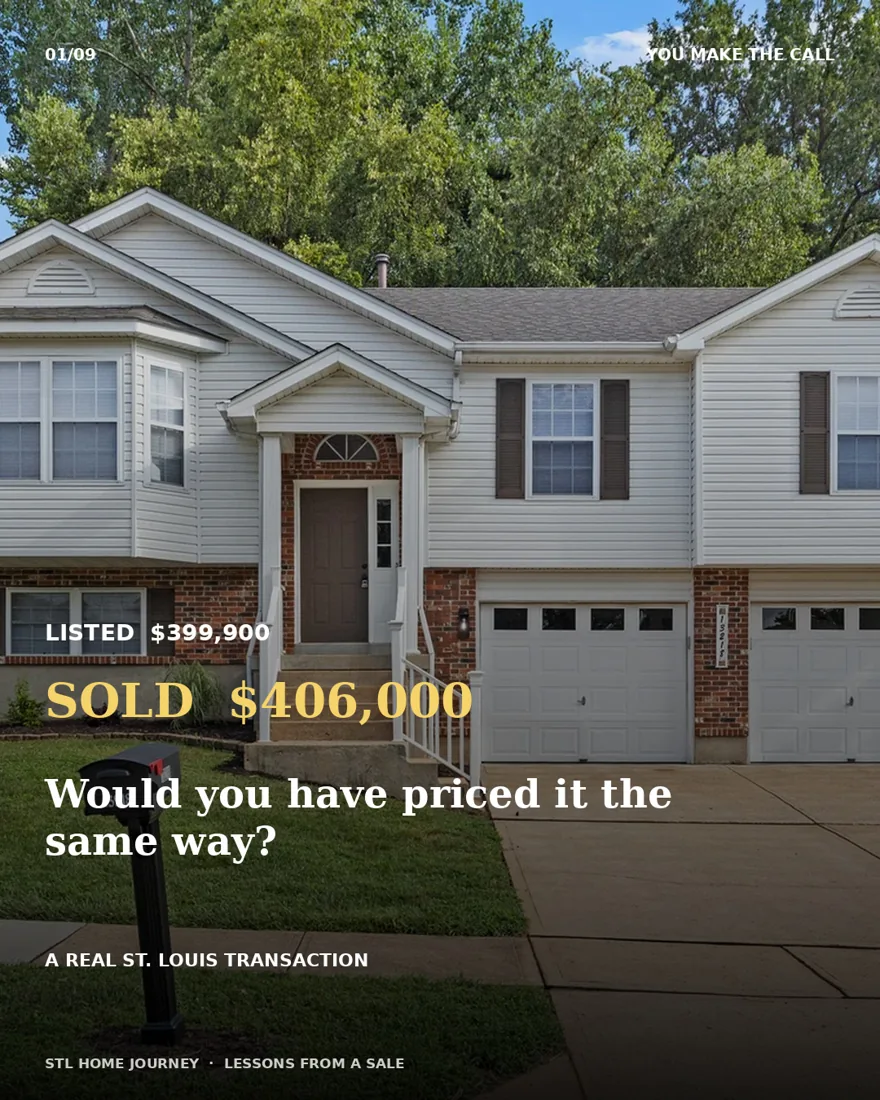
This home listed at $399,900 and sold for $406,000 — $6,100 over asking. Read that alone and you'd assume we priced it low, sparked a bidding war, and took the top offer. None of that is what happened.
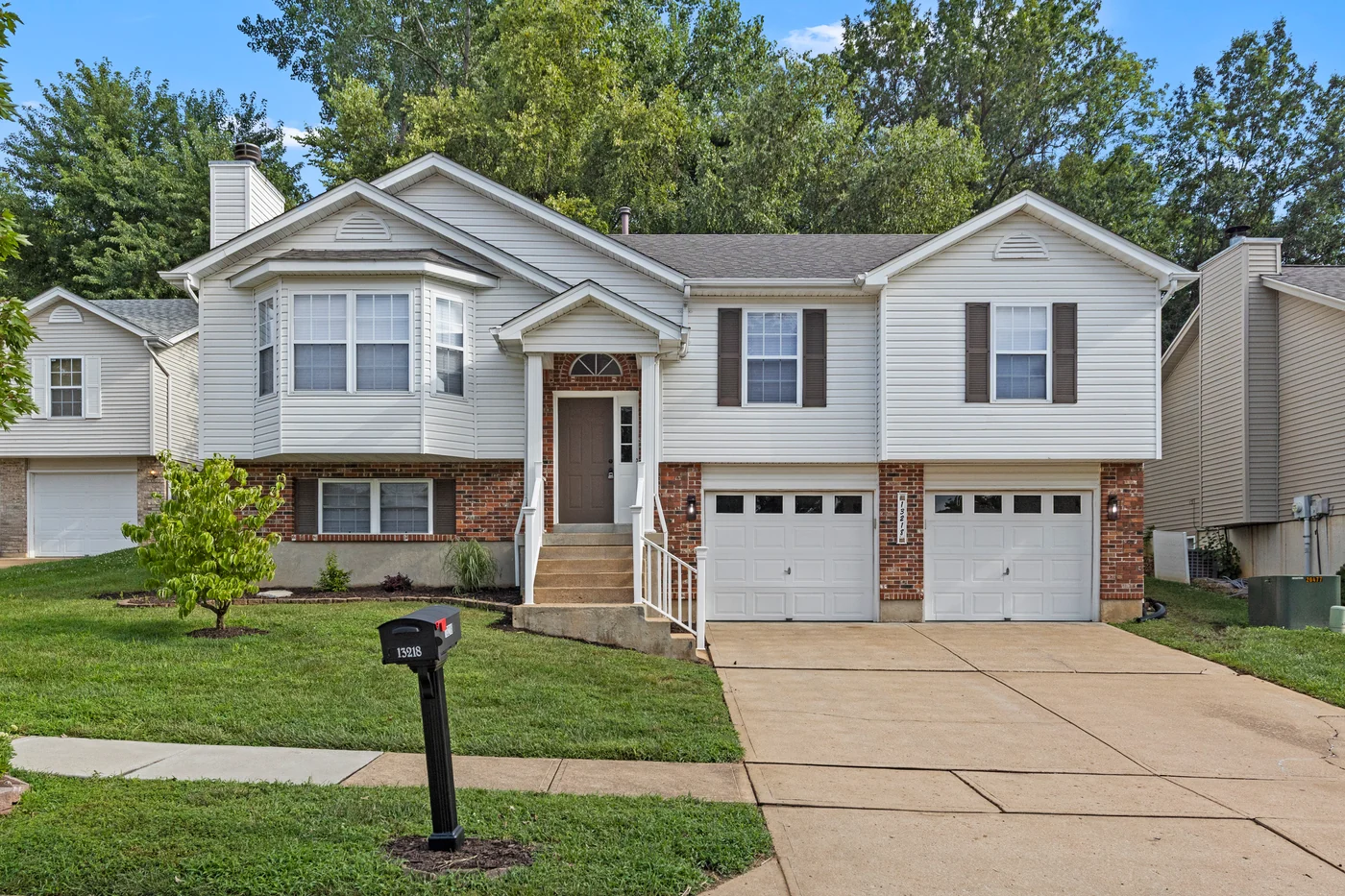
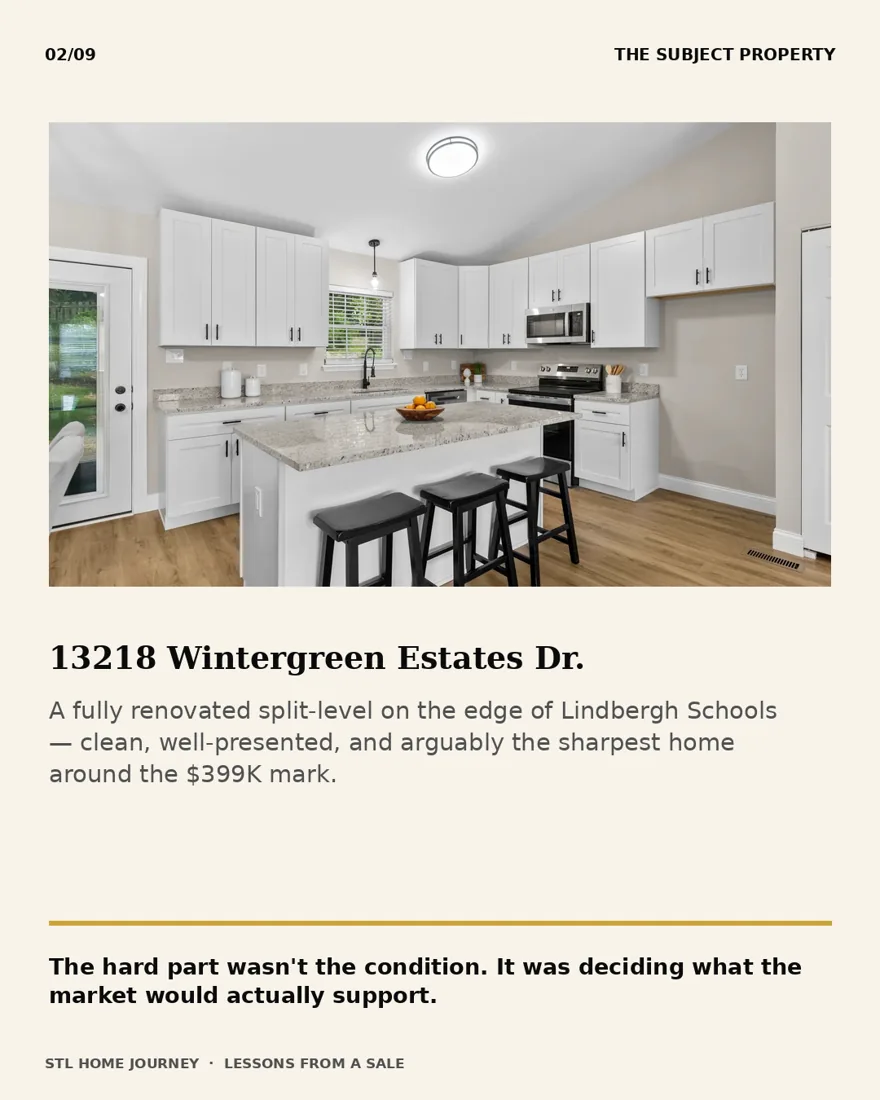
This was 13218 Wintergreen Estates Drive, a fully renovated split-level on the edge of the Lindbergh School District — clean, well-presented, no hidden issues, arguably the sharpest home around the $399K mark. The final number is the easy part of the story. The decisions behind it are the part worth learning from.
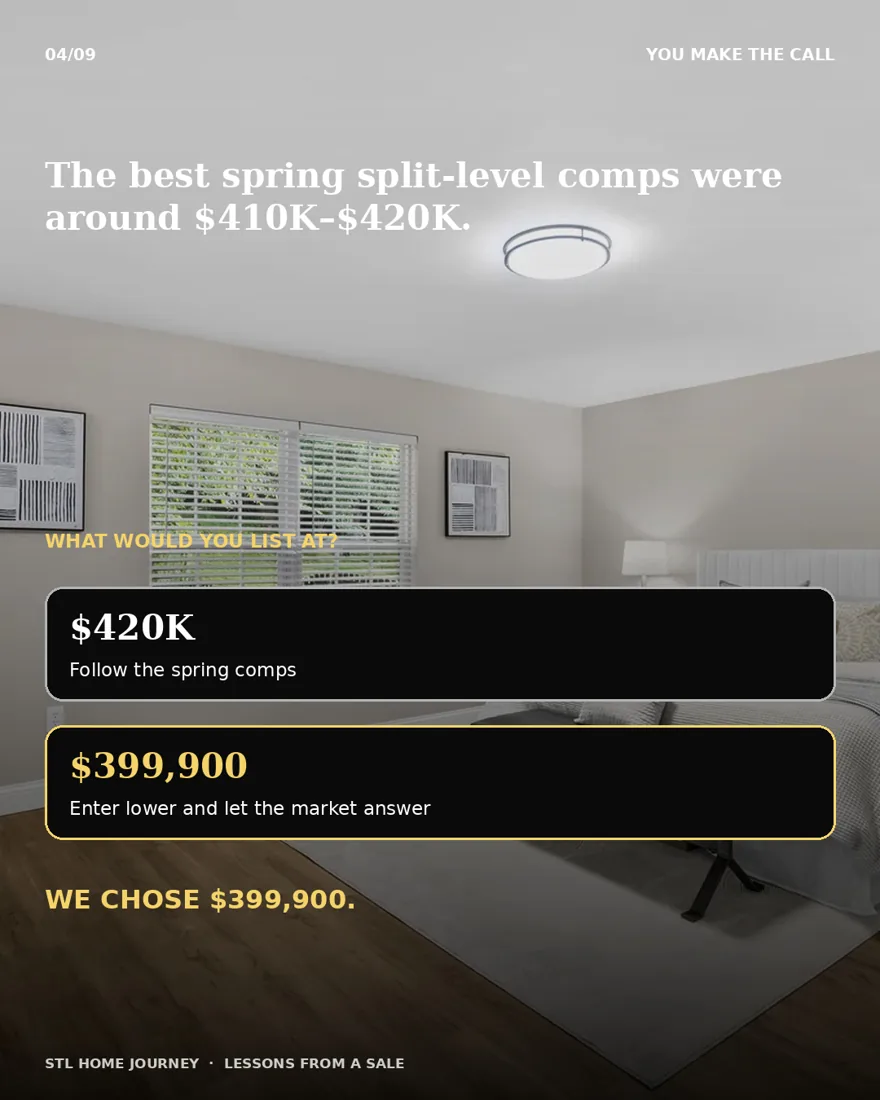
Price for the season you’re listing in, and use only true comps. Here that meant $399,900, below the two spring split-level sales at about $410,000 and $420,000, and ignoring a nearby $500,000 sale that wasn’t the same kind of house.
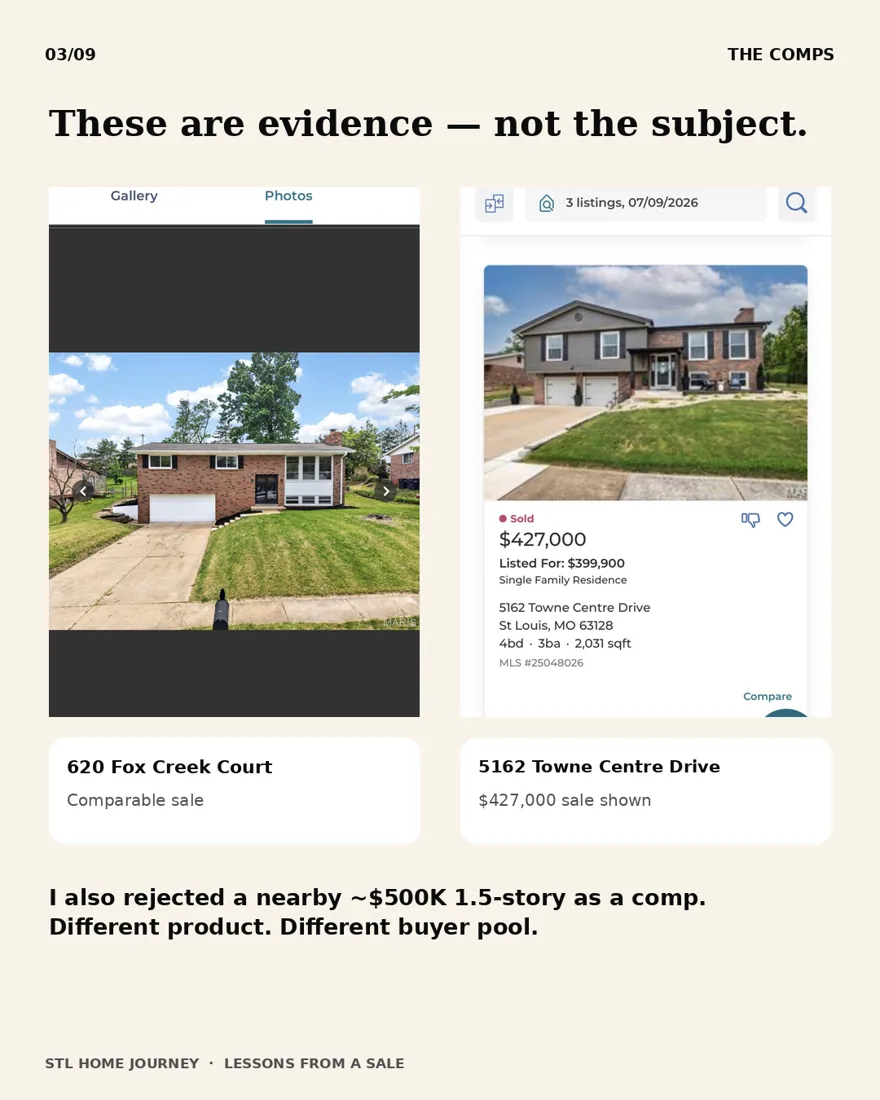
Split-levels aren't thick inventory in Lindbergh. I like four or five real comps to see a pattern; here I had two — both split-levels, both sold in the spring, at roughly $410,000 and $420,000.
There was also a nearby $500,000 sale. My seller asked about it. My answer was direct: I wouldn't even consider it.
It was a 1.5-story. We were selling a split-level. Those aren't the same product just because they're close together, and the highest sale nearby is not automatically the best evidence of your home's value.
Split-levels are a love-it-or-hate-it style with a narrower buyer pool than a ranch or two-story. I can't pretend a split's buyers behave like a 1.5-story's just because that sale would give us a bigger number. Adding a bad comp doesn't make a valuation more accurate.
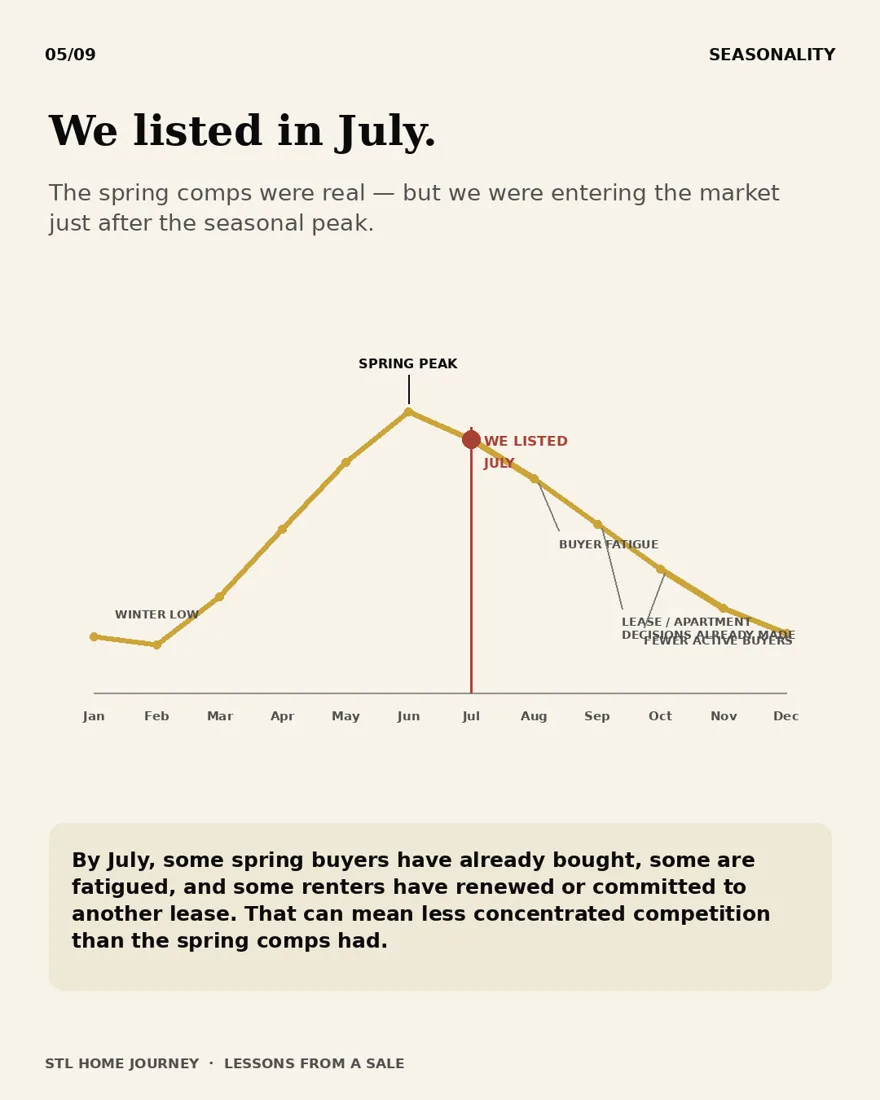
Appreciation doesn't climb straight up every month. Over years it trends up, but inside a single year demand rises and falls — a U-shape inside the longer trend. Spring is often the peak: more buyers, concentrated competition. By summer, some have bought, some are worn out, some just slow down.
Our two comps sold at that spring high. They were the best data I had, but I wasn't going to price a summer listing as if a summer buyer would behave like a spring one.
So I recommended $399,900 — not the highest number I could defend, but the right entry point for the market in front of us. The spring comps had also listed lower than they closed; if buyers valued the home above $399,900, their offers could show us. Start too high and you ask summer buyers to accept spring pricing with no reason to compete.
Your turn: price near the $420K spring comp, or enter at $399,900 and let the market push? — My seller agreed with $399,900. We listed there.
Sometimes, but not automatically. My preference was to take offers as they came, but my seller’s past success with deadlines and his upcoming vacation gave us a practical reason to set one, so we decided together. It passed after five days with two showings and no offers.
My seller asked what I thought about an offer deadline. My honest answer: I'd rather take offers as they come. I tend to see a deadline as a roadblock, and my instinct is to remove roadblocks, not add a reason for a ready buyer to wait.
He had a fair counter — he'd used deadlines successfully before. And there was a real reason to set one: he was leaving on vacation.
This wasn't me getting overruled. My job is to lay out what I see and the risks; the seller weighs that against his own experience and timing. I reminded him we were past the spring rush and into buyer fatigue — then asked when he wanted the deadline. We set it together.
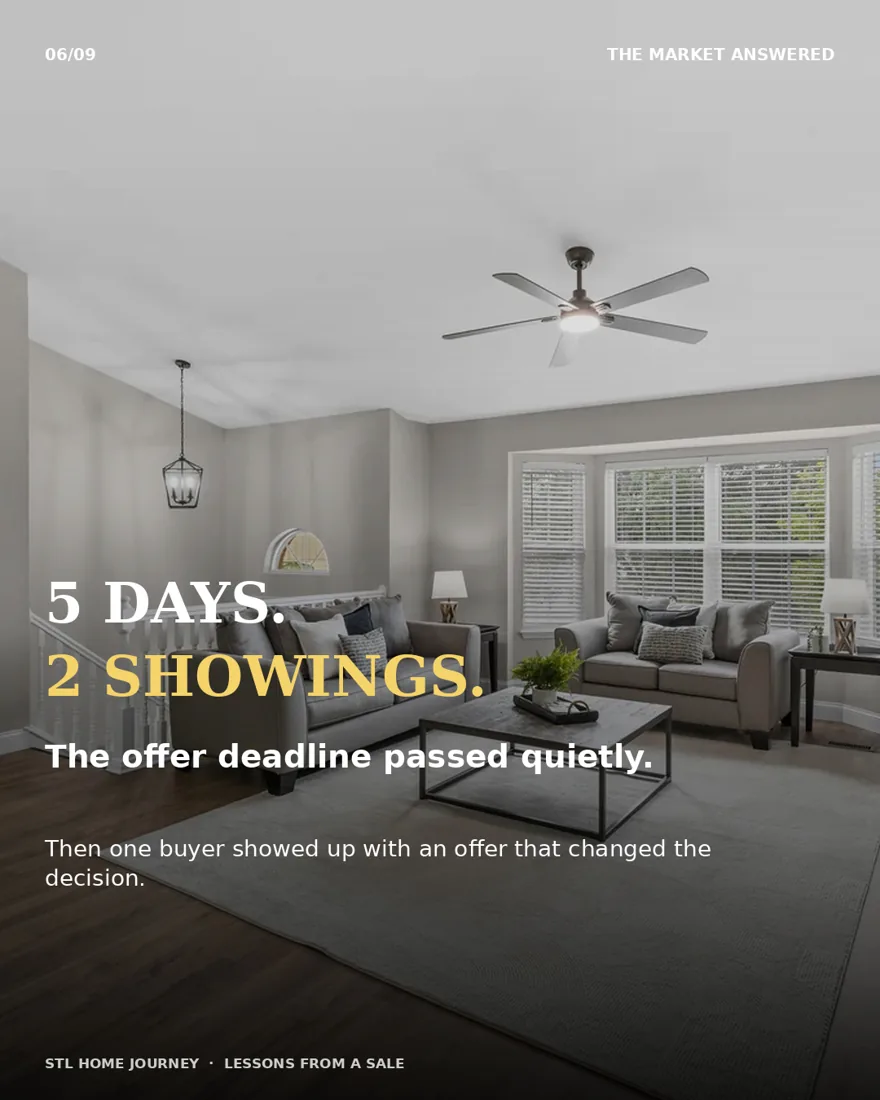
Your turn: skip the deadline, or set it given the vacation? — We set it. Then it passed at roughly five days on market, with two showings and no offers.
That's not the story people picture behind a sold-over-asking sign. But once the deadline passed with nothing under contract, showing activity picked up.
It can be, if you trust it. The $406,000 buyers kept every contingency in the contract, including the inspection, but their agent told me they wouldn’t ask for anything. Based on that agent and what I knew about the house’s condition, I treated it as about as strong as a $410,000 offer that might reopen the price over repairs.
Soon after the deadline, one buyer offered $406,000, and their agent told me they wouldn’t ask for any repairs. That promise mattered as much as the price.
Put $406,000 from a buyer who says they won't ask for anything next to a hypothetical $410,000 from a buyer who might. I don't automatically call the $410,000 stronger. The inspection is another place the deal can reopen — the buyer can inspect, raise concerns, and ask for repairs or credits.
A verbal promise isn't binding; these buyers could still have asked. I went on instinct about their agent and on knowing the house wouldn't present any issues. So the real comparison wasn't $406K vs. $410K — it was $406K with less uncertainty vs. $410K with another negotiation still ahead. A buyer who wants that promise to count can put it in writing by giving up Option 3, the repair request. The middle-ground inspection options →
For a deeper version of that logic, I wrote it up separately in multiple offers without overpaying.
Your turn: hold out for a higher number, or take $406K with no repair requests promised? — We took it.
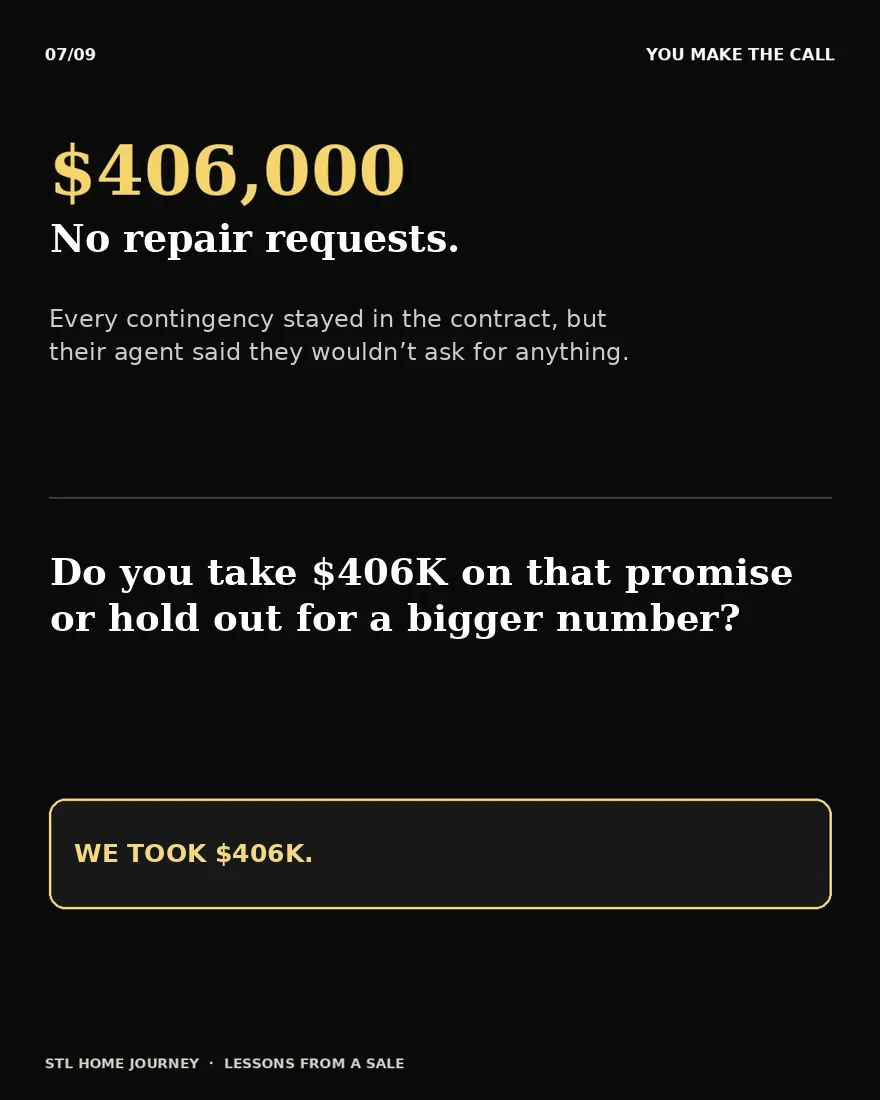
Yes. The buyers kept their word and asked for no repairs, the appraisal came in without a problem and there was no gap to solve. It closed fast at $406,000, $6,100 over list.
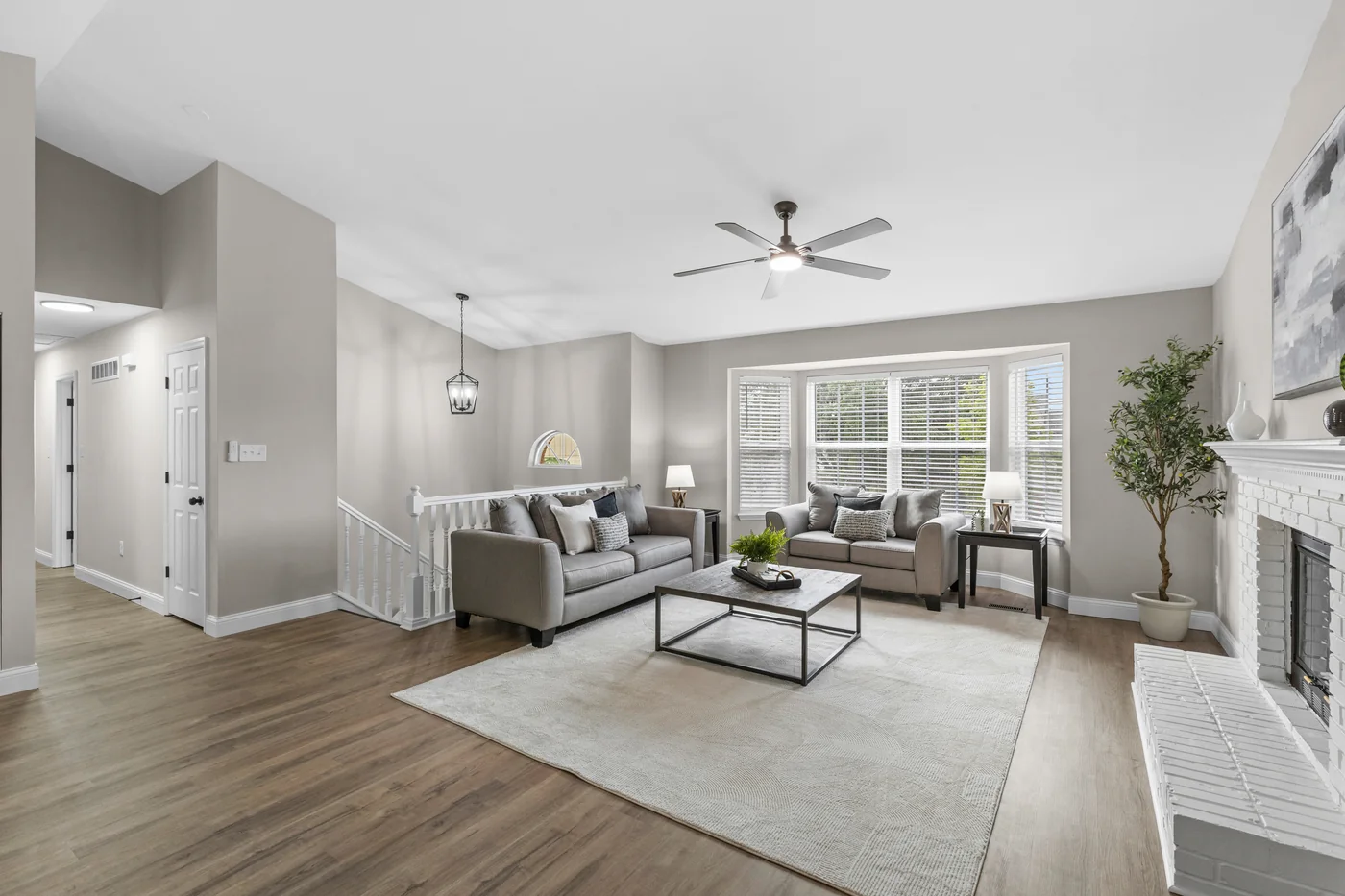

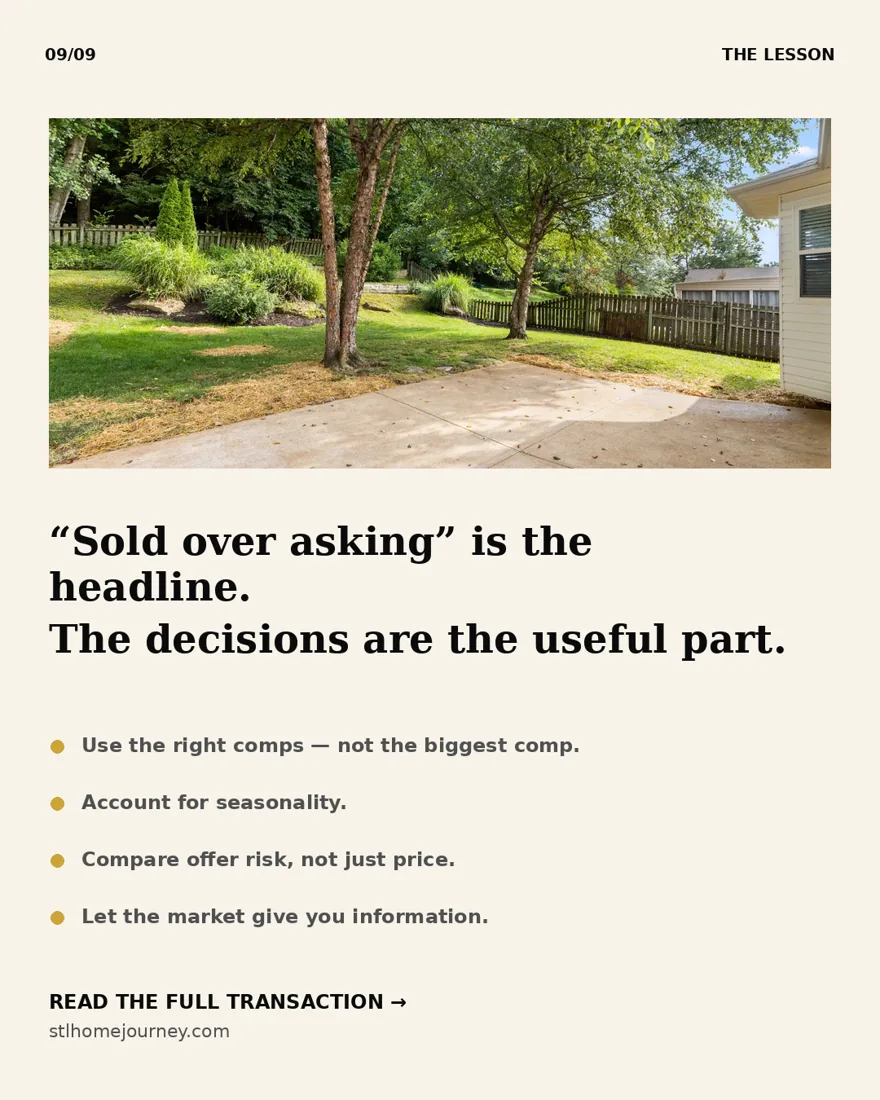
But "sold over asking" isn't the useful lesson. Two seasonally-older comps, a $500K sale I refused to treat as comparable, a $399,900 entry point, a deadline that passed quiet after five days and two showings — then one buyer at $406K whose agent promised no repair requests, and a clean appraisal. The number is part of the story. The decisions are the part sellers can use.
Price for the season you’re in, rely on true comps over convenient ones, and treat offer deadlines as a judgment call, not a rule.
1. Season matters even in a rising market. The spring comps at ~$410K and ~$420K were real evidence, not guarantees. Price for the market you're entering, not the one you wish were still here.
2. A true comp beats a convenient one. The $500K 1.5-story was easy to point at, but it didn't compete for the same buyer. With thin data, two good comps beat three with a bad one padding the number.
3. Deadlines are situational, not rules. My preference was to skip it; the vacation made setting one reasonable. We decided together. It passed without an offer — which shows why these calls need judgment, not formulas.
No. Long-term appreciation and seasonal demand are different things — values can trend up over years while buyer activity still rises and softens within a single year. Here, the spring comps mattered, but so did the softer summer market we listed into.
A comp should explain how buyers will value the home you're actually selling — so property type, condition, and buyer appeal matter as much as size and location. That's why I used the two split-level sales but not the nearby ~$500K 1.5-story.
More in this series: Lessons From a Sale · Right-sizing to Fenton (buyer side) · Related: How much to offer on a house · St. Louis school districts · Know your number first: buying power calculator