
STL Home Buyer Journey
George Kindler
13 Years Of Real Estate Experience At Your Fingertips
Last updated May 5, 2026
Buying is not automatically better than renting. The answer changes with your monthly payment, cash needed to close, maintenance risk and — most importantly — how long you expect to stay. A buyer who stays long enough to build equity can end up in a very different position from someone who buys and moves again two years later. Use the numbers on this page to compare the two paths for your situation instead of starting with the assumption that one always wins.
Most rent vs. buy calculators compare your rent payment to a mortgage payment and declare a winner. That is not how this works. Buying comes with property taxes, insurance, maintenance, and closing costs. Renting comes with annual increases, no equity accumulation, and no exposure to repair surprises. The real question is: over what time horizon does buying make financial sense in the St. Louis market right now?
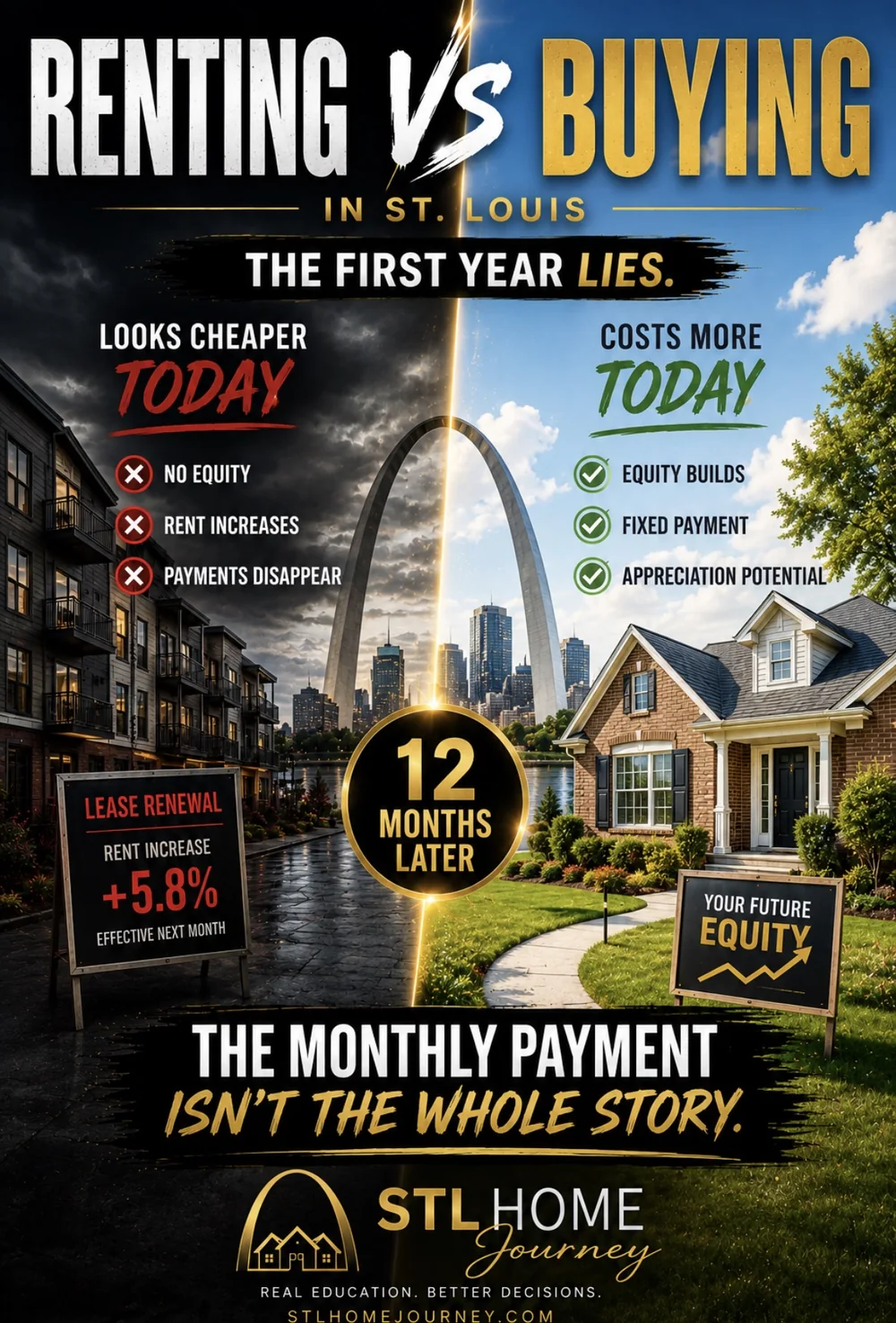
The monthly payment comparison is only the beginning. Equity, rent increases, and appreciation tell the rest of the story.
The following comparison uses a $220,000 home in South County with 5% down and a 6.75% mortgage rate versus a comparable rental unit. Property taxes are estimated at $3,200 annually (varies significantly by municipality).
| Cost Component | Buying ($220K) | Renting (comparable) |
|---|---|---|
| Principal + interest | $1,364/mo | -- |
| Rent | -- | $1,450/mo |
| Property taxes | $267/mo | -- |
| Homeowner's insurance | $110/mo | -- |
| Renter's insurance | -- | $20/mo |
| PMI (5% down) | $73/mo | -- |
| Maintenance reserve (1%/yr) | $183/mo | -- |
| Total monthly | $1,997/mo | $1,470/mo |
On this comparison, buying costs $527 more per month initially. But that gap narrows as rent increases (at 6-7% annually) while the mortgage payment stays fixed, and equity accumulates on the purchase side.
At 4.2% annual appreciation, a $220,000 St. Louis home is worth approximately $270,000 in five years. Combined with principal paydown over that period, the buyer has built roughly $60,000 to $70,000 in equity. The renter has built zero equity and is paying $1,800+ per month in rent by year five due to annual increases.
The break-even calculation -- the point at which buying becomes financially superior to renting -- in the St. Louis market generally falls between 3 and 5 years, depending on the price point, neighborhood, and what the buyer would have done with the down payment instead.
St. Louis has one of the lowest price-to-rent ratios of any major metro in the country. This means owning is relatively cheap compared to renting -- the same quality of housing generally costs less to buy than to rent on a monthly basis over a 5-year horizon. This is one reason why St. Louis consistently ranks among the most affordable homeownership markets nationally despite having strong neighborhoods and employment bases.
The implication: in most St. Louis markets, the financial case for buying is stronger than in coastal cities where price-to-rent ratios are much higher. The question is not usually whether buying is better long-term -- it usually is in St. Louis -- but whether your specific timeline and situation support it now.
Before you decide -- understand what you can actually qualify for. Mortgage Pre-Approval in St. Louis → → True monthly cost by zip code -- taxes, insurance, and PITI across 79 St. Louis areas. St. Louis Affordability by Zip Code → → Where your budget goes furthest in the St. Louis market right now. Most Affordable St. Louis Zip Codes 2026 → →Renting is almost certainly the right call. Transaction costs to buy and sell eat the equity gains in a 2-year window. The 5% to 8% of purchase price you spend getting in and out leaves little room for appreciation to compensate. Stay liquid, save the down payment, and buy when the timeline is 4+ years.
Buy. At 4.2% annual appreciation in the St. Louis metro, a $250,000 home is worth approximately $307,000 in five years. Combined with principal paydown, you have built $70,000+ in equity. Rent in comparable neighborhoods has increased by $500 to $700 per month in the same period. The math is unambiguous over 5 years in St. Louis.
Rent until the uncertainty resolves. A forced sale within 18 to 24 months of purchase, particularly if the market has softened, can produce a loss after transaction costs. The option value of being able to move without the friction of a home sale is worth paying rent for a defined period.
Is it cheaper to rent or buy in St. Louis right now?
In the short term (under 2 years), renting is typically cheaper after accounting for transaction costs, maintenance, taxes, and insurance. Over a 4 to 5 year horizon, buying is almost always financially superior in the St. Louis market due to equity accumulation, fixed mortgage payments, and St. Louis's favorable price-to-rent ratio. The specific numbers depend heavily on the price point, zip code, and current interest rate.
How long do you need to stay in a house in St. Louis to make buying worth it?
The general break-even horizon in St. Louis is 3 to 5 years. Homes bought in high-appreciation areas like South County, Kirkwood, and Webster Groves break even faster. Homes in slower-appreciating areas or markets with higher transaction costs take longer. If your timeline is under 2 years, renting is almost always the better financial choice.
What is a good price-to-rent ratio in St. Louis?
A price-to-rent ratio under 15 generally favors buying; over 20 generally favors renting. St. Louis has one of the lowest price-to-rent ratios among major metros, meaning the math tilts toward buying more strongly here than in most coastal cities. Many St. Louis neighborhoods have ratios in the 10 to 14 range.
What are the upfront costs of buying a home in St. Louis?
Upfront costs for a St. Louis home purchase include down payment (3% to 20% of purchase price), closing costs ($5,000 to $12,000 depending on loan type and price), inspection fees ($600 to $1,000), and moving costs. Plan for total upfront costs of approximately 5 to 8 percent of the purchase price depending on your down payment size and loan type.
This is one piece of the St. Louis home buying process. See how it all fits together:
📚 Complete St. Louis Buyer Guide →If you're trying to decide whether to wait for rates or move now, this is worth reading first: St. Louis buyers may have a bigger problem than rates — why the crowd waiting beside you might be the real risk.

Grew up in South St. Louis, lived in Dogtown for 6 years, now in South County. You'll find us at Wellspring on Lindbergh on Sundays. I'm not selling you a house — I'm showing you how to think about buying or selling a house.
Questions about what you are reading? I answer personally -- no team, no handoff.