
Buying a House in Kirkwood, Missouri
A mature suburb with one of the region's strongest names, an active downtown core, and a historic train-station identity that still shapes how the place feels.
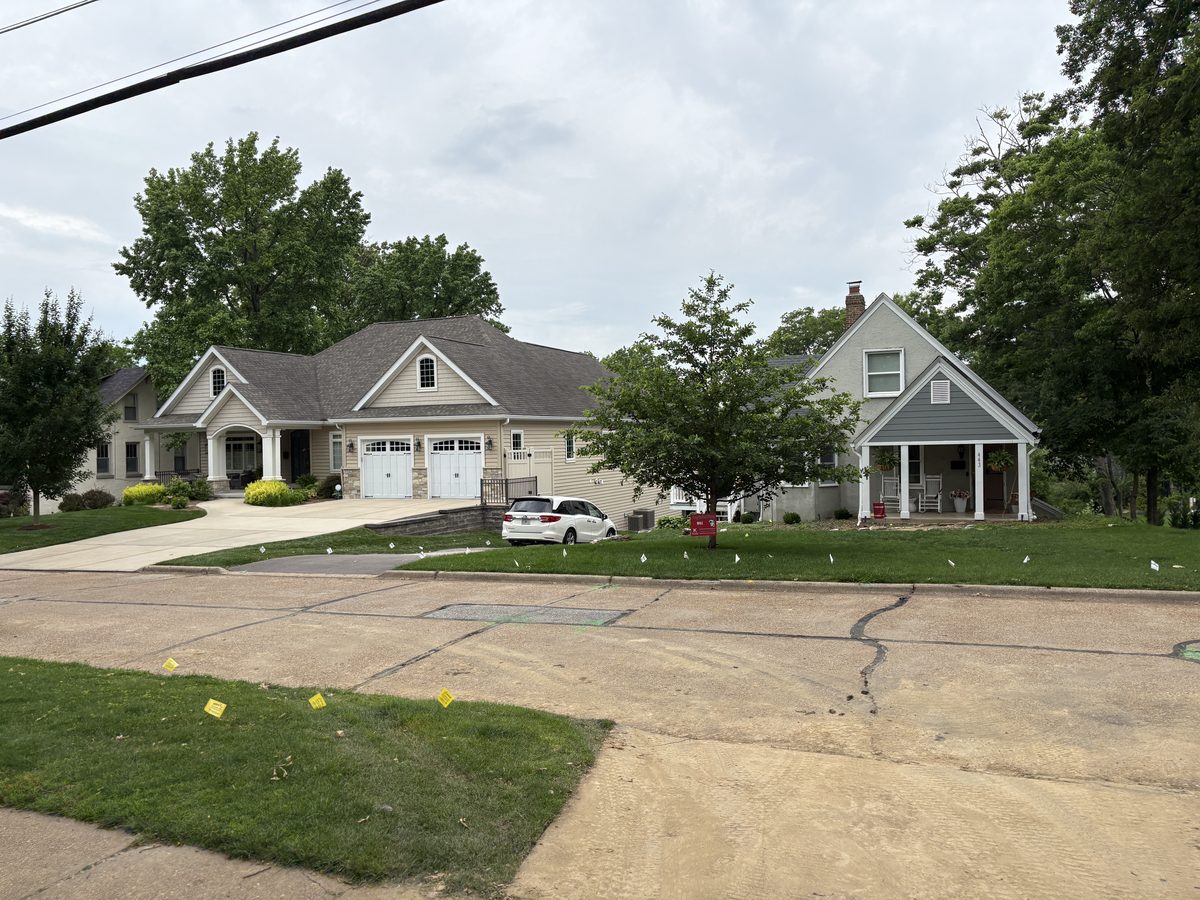
Kirkwood Home Buying Questions, Answered With 2026 Sales
Short answers first. Each one links to the sales behind it further down the page.
How much do houses cost in Kirkwood, Missouri?
In 80 sales inside the City of Kirkwood’s Census boundary that closed between January 8 and October 1, 2026, the median sale price was $566,750. The middle half sold between $388,750 and $807,500, and the full range ran from $75,000 to $2,750,000.
That’s a different measure from the Census median owner value for Kirkwood (about $451,400), which reflects owners’ estimates of all homes, not recent sales.
Can I buy a house in Kirkwood for $400,000?
21 of 80 sales (26.2%) closed at $400,000 or less. Of those 21, 11 had three or more bedrooms, 10 had two or more baths and 11 were ranch-style. Their median was 1,263 sq ft, built in 1948.
What does $500,000 buy in Kirkwood?
35 of 80 sales (43.8%) closed at $500,000 or less. Of those 35, 23 had three or more bedrooms, 24 had two or more baths and 16 were ranch-style. Their median was 1,506.5 sq ft, built in 1948.
How fast do houses sell in Kirkwood?
The median sale spent 6 days on market (CDOM). A quarter of the 80 sales took 3 days or less; the slowest quarter took about 22 days or more. 18 sales took 30+ days, 7 took 60+ and the longest took 157.
Do Kirkwood homes sell over asking?
Measured against the original list price, 45 of 80 (56.2%) closed above it, 7 (8.8%) at it and 28 (35.0%) below it. The median sale was 102.1% of the original ask.
What kind of houses are common in Kirkwood?
Mostly older houses. Of the 80 sales, 53 (66.2%) were built before 1960, 7 (8.8%) from 1960 to 1979, 7 (8.8%) from 1980 to 1999 and 13 (16.2%) in 2000 or later. The median house was about 2,315 sq ft, built in 1951, and 20 of 80 (25.0%) listed a ranch style.
Does a Kirkwood mailing address mean the house is in the City of Kirkwood?
Not necessarily. All 80 sales inside the city boundary were in ZIP 63122, but 63122 also covers neighboring communities. 66 of the 80 listed “Kirkwood” as the city in MLS and 14 listed “St Louis.” Check the St. Louis County GIS map for the exact address.
Is all of Kirkwood in the Kirkwood School District?
All 80 sales inside the city boundary this year were in the Kirkwood R-VII School District. District lines don’t always follow city limits, so verify the assigned schools for the exact address before you write an offer.
Is Kirkwood its own city?
Yes. Kirkwood is an incorporated city in St. Louis County with its own city government. Before you close, ask the city what it requires when a house changes hands, such as an occupancy permit or inspection.
Source: 80 closed sales inside the City of Kirkwood’s Census boundary, January 8–October 1, 2026. Location from each listing’s map coordinates against the Census Bureau’s 2024 boundary. Historical sales, not current inventory.
What Does Your Money Actually Buy in Kirkwood?
Most neighborhood guides describe how an area feels. This section shows what actually sold.
I counted 80 closed 2026 sales whose map location falls inside the Census Bureau’s boundary for the City of Kirkwood. That’s the definition used on this page, not every 63122 address.
Sold prices ran from $75,000 to $2,750,000, and the median original list price was $562,500. The typical house had 3 bedrooms and 3 bathrooms and was built in 1951.
What Your Budget Reached in Kirkwood
A preapproval tells you what a lender will allow. This shows how much of the Kirkwood market actually closed at or below each number.
Kirkwood’s market is wide. $400,000 reached 21 of 80 sales, and it took $800,000 to reach about three-quarters of them.
Budget counts include sales exactly at each threshold. This is historical closed-sale data, not today’s inventory.
Kirkwood by Price Band
Each row is a slice of the same 80 sales. Read the sale count before the median.
| Price band | Sales | Median sold | Median CDOM | Median sq ft | Median sale ÷ original ask |
|---|---|---|---|---|---|
| Under $300K | 9 | $270,000 | 15 | 992 | 95.0% |
| $300K–$399,999 | 12 | $355,000 | 5.5 | 1,412.5 | 102.3% |
| $400K–$499,999 | 13 | $462,900 | 6 | 2,058 | 104.4% |
| $500K–$599,999 | 9 | $528,000 | 6 | 2,353 | 102.2% |
| $600K–$999,999 | 22 | $749,000 | 4 | 2,780.5 | 109.5% |
| $1M+ | 15 | $1,375,000 | 10 | 4,228 | 100.0% |
The bands under $600,000 have 9 to 13 sales each. Read them as examples, not stable estimates.
What Changes When You Add $100,000?
| Budget | Sales at or below | Share of sales | Change from previous step |
|---|---|---|---|
| $300,000 | 9 | 11.2% | — |
| $400,000 | 21 | 26.2% | +15.0 points |
| $500,000 | 35 | 43.8% | +17.5 points |
| $600,000 | 43 | 53.8% | +10.0 points |
| $700,000 | 50 | 62.5% | +8.8 points |
| $800,000 | 59 | 73.8% | +11.2 points |
From $300,000 to $500,000, each $100,000 step added 12 to 14 sales. Above $500,000, each step added 7 to 9.
The House Changes Too
| Price band | Beds | Baths | Sq ft | Year built | Ranch share |
|---|---|---|---|---|---|
| Under $300K | 2 | 1 | 992 | 1947 | 55.6% |
| $300K–$399,999 | 3 | 2 | 1,412.5 | 1948 | 50.0% |
| $400K–$499,999 | 3 | 2 | 2,058 | 1948 | 38.5% |
| $500K–$599,999 | 4 | 3 | 2,353 | 1951 | 22.2% |
| $600K–$999,999 | 4 | 3 | 2,780.5 | 1961 | 4.5% |
| $1M+ | 5 | 5 | 4,228 | 2011 | 6.7% |
Under $300,000, the typical sale was a 2-bedroom, 1-bath house of about 992 sq ft built around 1947. The $1M+ band was mostly newer construction: a median of 4,228 sq ft built in 2011.
How Quickly Did Kirkwood Homes Actually Sell?
| Price band | Median | Middle half (25th–75th) | Longest |
|---|---|---|---|
| Under $300K | 15 | 6–30 | 138 |
| $300K–$399,999 | 5.5 | 3–19.2 | 63 |
| $400K–$499,999 | 6 | 4–51 | 157 |
| $500K–$599,999 | 6 | 4–32 | 40 |
| $600K–$999,999 | 4 | 2.2–17.5 | 128 |
| $1M+ | 10 | 3–17 | 60 |
Most Kirkwood homes sold quickly: the median was 6 days. The $600K–$999,999 band was the fastest, at a 4-day median.
Did Kirkwood Sellers Get Their Original Asking Price?
| Price band | Above | At | Below | Median sale ÷ original ask |
|---|---|---|---|---|
| Under $300K | 2 | 1 | 6 | 95.0% |
| $300K–$399,999 | 7 | 0 | 5 | 102.3% |
| $400K–$499,999 | 8 | 0 | 5 | 104.4% |
| $500K–$599,999 | 5 | 0 | 4 | 102.2% |
| $600K–$999,999 | 18 | 0 | 4 | 109.5% |
| $1M+ | 5 | 6 | 4 | 100.0% |
The $600K–$999,999 band was the most competitive: 18 of 22 sales closed above the original ask, at a median of 109.5%. Under $300,000, 6 of 9 closed below it.
Original asking price reflects each seller’s pricing decision, so this isn’t an offer formula.
How This Kirkwood Analysis Was Built
This analysis uses 80 closed-sale records from the STL Home Journey 2026 St. Louis County sales dataset (January 8–October 1, 2026). A sale counts here when its listing’s map coordinates fall inside the Census Bureau’s boundary for the City of Kirkwood, using the U.S. Census Bureau’s 2024 TIGER/Line place boundary. The same records feed the St. Louis County school district housing analysis.
- Historical closed sales are not current inventory.
- Days on market uses CDOM.
- Sale ÷ original ask compares the close price with the original list price.
- Ranch share counts any MLS style that includes “Ranch.”
- Listing coordinates can be imprecise near the boundary. Verify jurisdiction and school assignment for the exact address.
Schools in Kirkwood
All 80 of this year’s sales inside the city boundary were in the Kirkwood School District. District lines don’t always follow city limits, so confirm the assigned schools for the exact address before you write an offer.
⚠ School boundaries can vary by exact property address. Verify assigned schools directly with the district, county records, or your buyer agent before writing an offer.
Fixer Upper vs. Move-In Ready
School district confirmed. Now the real question — what does your budget actually buy here on both paths? The comparison tool shows which St. Louis neighborhoods offer a genuinely equivalent home within 5% of the same total cost. FHA, VA, and conventional math included.
A Suburb With a Strong Center, Not Just Good Branding
Kirkwood stays on buyer shortlists because it offers more than name recognition. It has a real center of gravity: downtown, the train station, and a municipal identity that feels older and more established than a typical postwar suburb.
The Census Bureau lists Kirkwood's 2020 population at 29,461, and city materials describe Kirkwood as nine square miles in size. That is large enough to offer variety, but compact enough to still feel coherent.
When buyers say they want an inner-ring suburb with a real sense of place, Kirkwood is often what they are trying to describe.
Verified Context That Actually Helps
George's read: The key with Kirkwood is that the name and the physical place still line up. Downtown matters. The train station matters. The suburb feels like itself.
Downtown and the Train Station Still Set the Tone
The city's historic train station page says the Kirkwood station was built in 1893 and remains one of the city's most enduring buildings. That is not trivia; it helps explain why Kirkwood still feels anchored by place rather than by sheer subdivision spread.
The city also highlights Downtown Kirkwood as a distinct business district, which separates Kirkwood from suburbs that are mainly residential without a strong center.
What Buyers Actually Find Here
Kirkwood buyers are usually balancing charm, convenience, and price tolerance. It is a high-demand suburb, so buyers do not get Kirkwood value by accident.
There is meaningful variety inside the city — older homes near the center, more traditional suburban pockets, and different tradeoffs between lot size and proximity to downtown amenities.
What usually holds demand together is that the suburb feels complete. Buyers understand what they are getting, and that reduces hesitation.
See where neighborhood choice fits inside the affordability chapter.
Review the inspection chapter before you commit to an older house.
The Buyer Profiles That Usually Click Here
Grew up in South St. Louis, lived in Dogtown for 6 years, now in South County. You'll find us at Wellspring on Lindbergh on Sundays. I'm not selling you a house — I'm showing you how to think about buying or selling a house.
Wondering whether to stay or go?
If you’ve been in the house for years, start with Longtime St. Louis Homeowner: Should You Stay or Should You Go? — what staying really costs, what you’d walk away with, and where you’d go next.
Questions Buyers Ask Before They Commit
Where is Kirkwood?
Kirkwood is an incorporated city in St. Louis County, southwest of the City of St. Louis.
How big is Kirkwood?
City materials describe Kirkwood as about nine square miles.
How many people live in Kirkwood?
The Census Bureau lists 29,461 residents in the 2020 Census.
What is Kirkwood known for?
It is especially known for Downtown Kirkwood and the historic train station built in 1893.
Why do buyers search Kirkwood so often?
Because it combines a strong suburb brand with a real center and durable owner-occupant demand.
Want to Run Your Actual Search?
These numbers describe Kirkwood as a whole. Your search is narrower: a budget, a bedroom count, a house type and the things you won’t compromise on.
The useful question is how often that house has actually come up here, and what happened when it did. Ask me.
Call George · 314.435.1087 Run Affordability FirstComplete St. Louis Home Buyer Guide
From pre-approval to closing day — see the complete buying process with all resources organized by stage.
📚 View Complete Guide