
STL Home Buyer Journey
George Kindler
13 Years Of Real Estate Experience At Your Fingertips
Last updated July 10, 2026
Closing costs are the category of home buying expenses that most buyers underestimate -- or do not think about until they receive their Closing Disclosure three days before the table. Here is every line item, what it costs in St. Louis, how to read your documents, and how to get some of it covered.
Highlighted items are the ones that surprise buyers most. On a $250,000 purchase, the total below the waterline typically runs $5,000–$12,000 beyond the down payment.
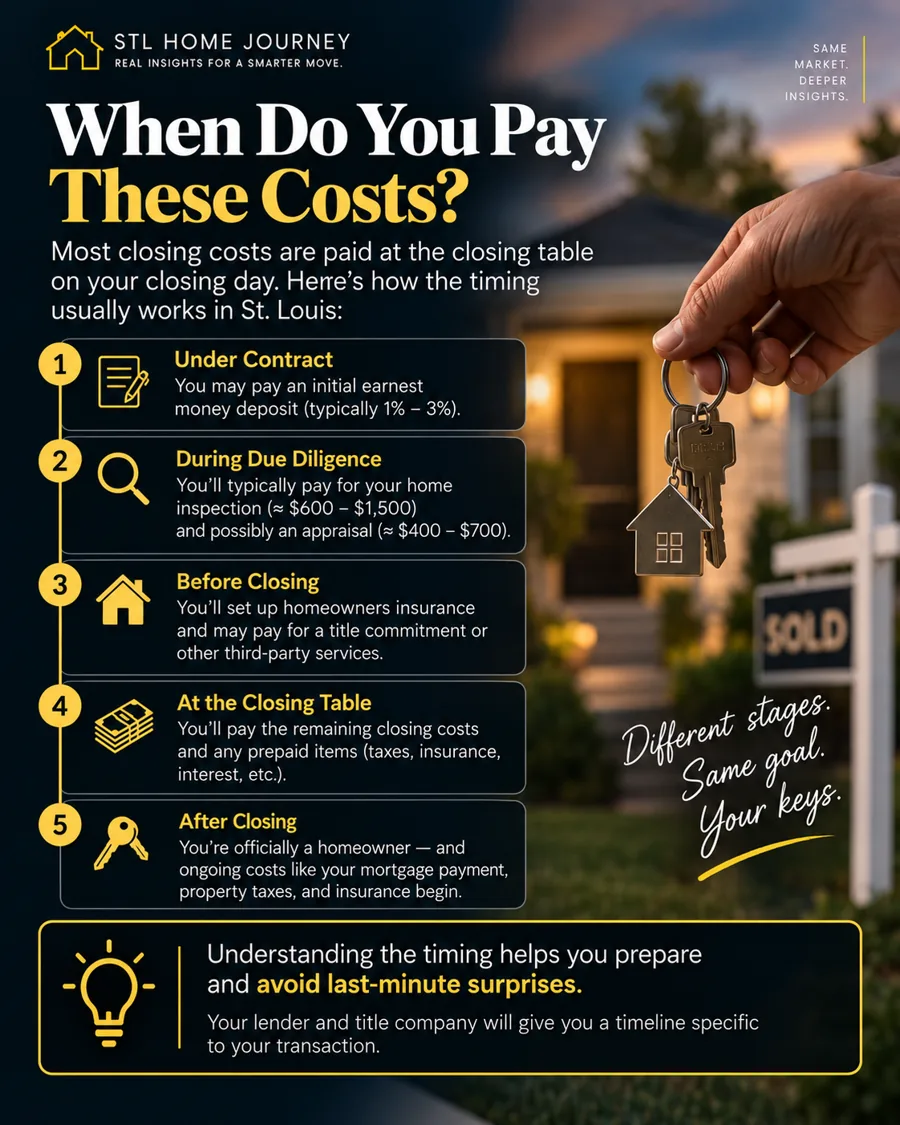
Closing costs are the fees and prepaid expenses required to complete a real estate transaction. They are separate from your down payment. They are paid at the closing table -- or more accurately, they are wired in advance as part of the total cash to close.

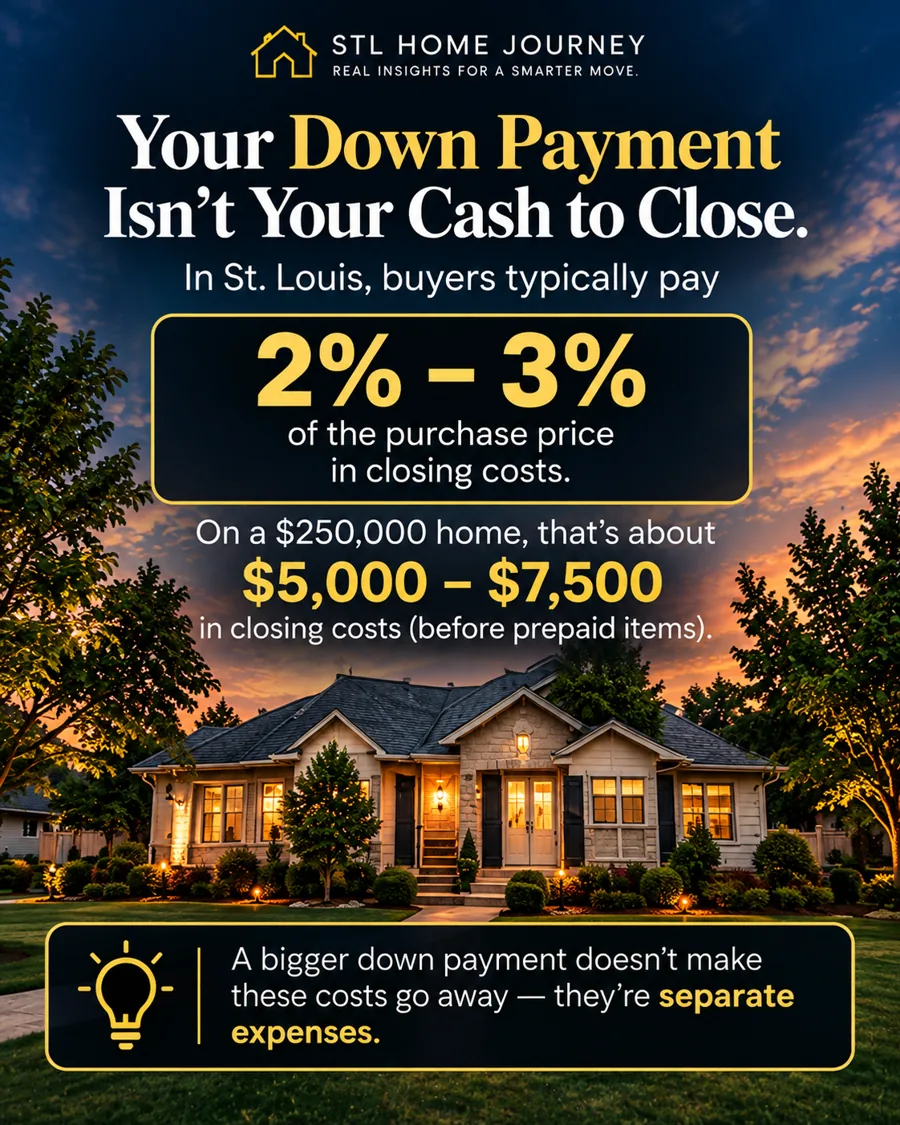
In St. Louis, buyers typically pay 2% to 3% of the purchase price in closing costs. On a $250,000 home, that is $5,000 to $7,500 on top of whatever down payment you are making. When you add in all prepaid items -- discussed below -- the total additional cash can reach $8,000 to $12,000. This number surprises buyers who only planned for the down payment.
These two terms are not interchangeable. Closing costs are the fees -- lender fees, title fees, recording fees. Cash to close is the total amount you wire to the title company: your down payment, plus closing costs, plus prepaid items. Most buyer confusion at the closing table comes from only budgeting for closing costs and forgetting the prepaids.
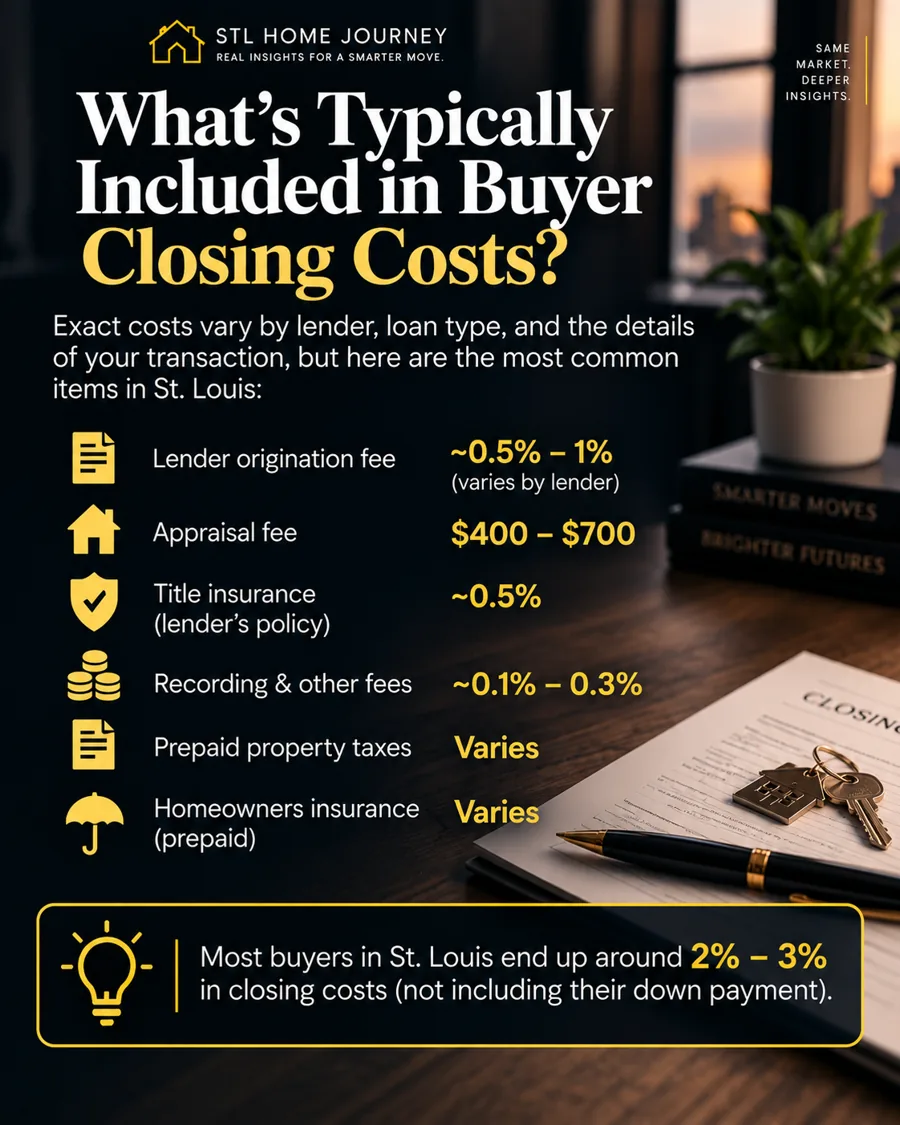
These are fees charged by your mortgage lender for originating and processing the loan:
These fees are paid to the title company that manages the closing and insures the title:
These are not fees -- they are expenses you would pay regardless, collected upfront at closing:

Based on a $250,000 loan at 6% (~$41/day). Close earlier = more prepaid interest collected at closing. Close near end of month = less cash due at closing.
Missouri does not have a transfer tax on residential real estate -- unlike many states. This is a meaningful savings for St. Louis buyers. The primary government fees at closing are the recording fees noted above: typically $100 to $200 paid to the county to record the deed and mortgage in public records.
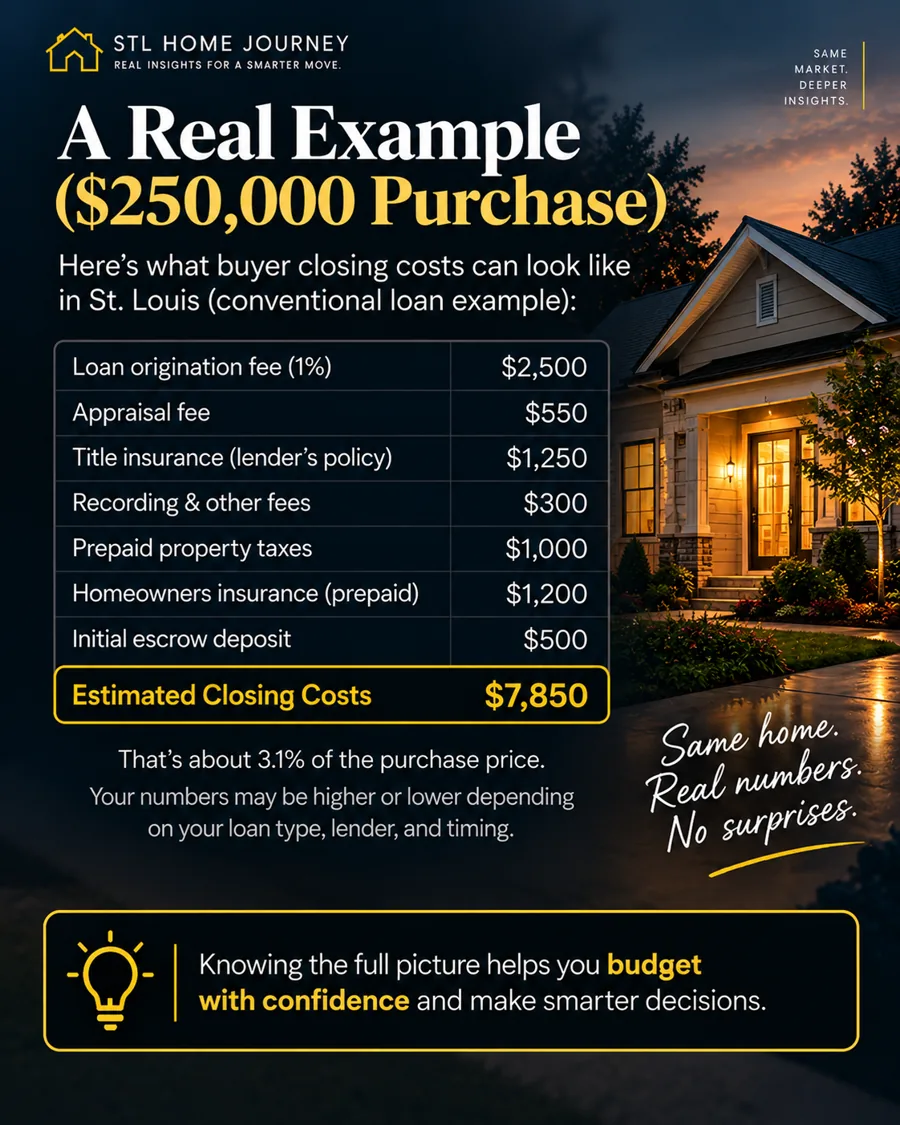
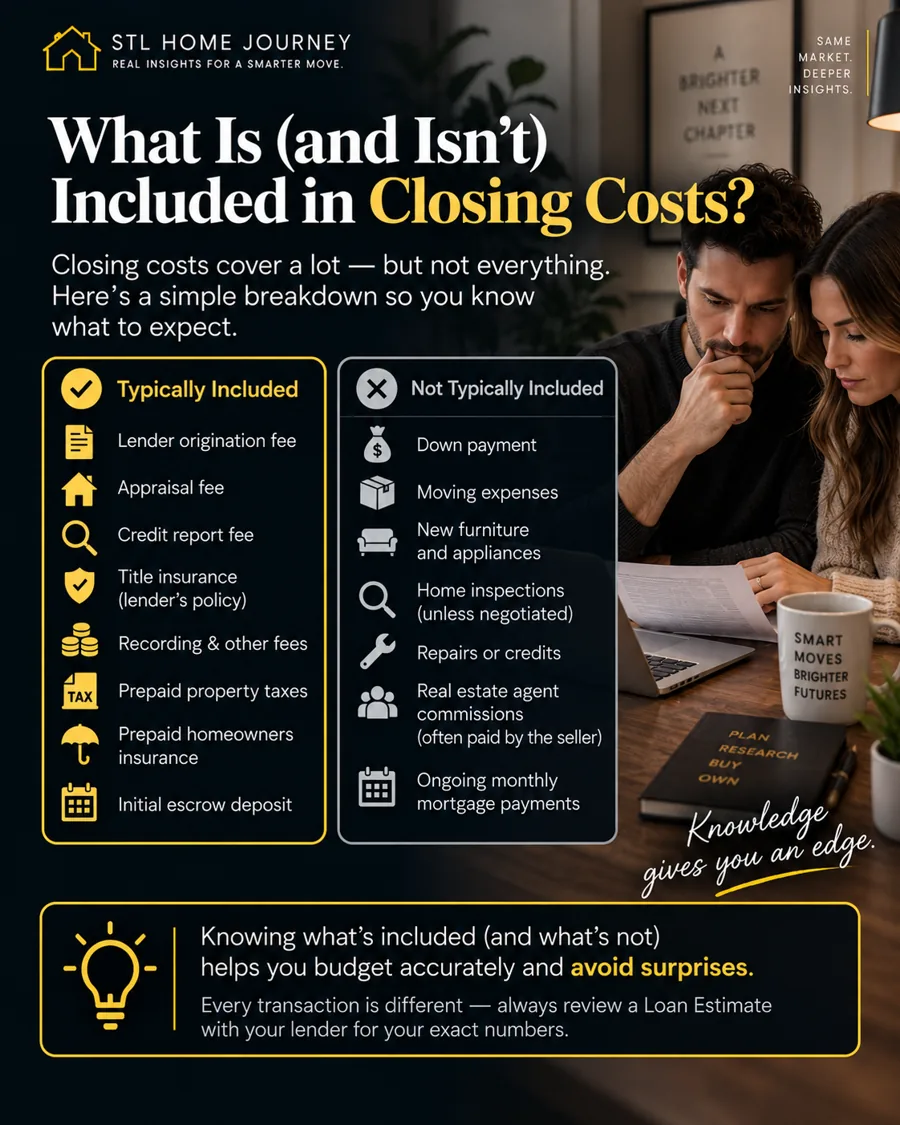
| Cost | Example on a $250,000 purchase |
|---|---|
| Loan origination fee (1%) | $2,500 |
| Appraisal fee | $550 |
| Title insurance (lender's policy) | $1,250 |
| Recording & other fees | $300 |
| Prepaid property taxes | $1,000 |
| Homeowners insurance (prepaid) | $1,200 |
| Initial escrow deposit | $500 |
| Estimated closing costs | $7,850 |
That’s about 3.1% of the purchase price. Your numbers may be higher or lower depending on your loan type, lender, and timing.
Yes -- and this is a negotiating tool worth understanding before you make any offer. Sellers can offer closing cost concessions in the purchase contract. The concession is listed as a dollar amount or percentage that the seller will credit toward your closing costs at the table.
Concessions reduce the seller's net proceeds. They cannot exceed your actual closing costs -- any excess is lost, not refunded to you as cash. Source: Fannie Mae Selling Guide, HUD guidelines, VA guidelines.
The concession reduces the net proceeds the seller receives -- which is why it is a negotiating point, not a guarantee. In a buyer-favorable market or on a home that has been sitting, asking for seller concessions is reasonable and common. In a competitive multiple-offer situation, asking for concessions may cost you the deal.
One important note: seller concessions cannot exceed your actual closing costs. If your closing costs are $7,000 and the seller agrees to $10,000 in concessions, the extra $3,000 is not refunded to you -- the concession is simply capped at the actual amount owed.
Down payment requirements by loan type -- and assistance programs that can also offset closing costs. How Much Down Payment Do You Need in St. Louis? → → Your loan type determines how much the seller can contribute. Here is how FHA and conventional compare for St. Louis buyers. Conventional vs. FHA Loan in St. Louis → →Closing costs are not fixed. There are several legitimate ways to reduce them:
This is worth saying directly because buyers frequently confuse these with closing costs:
Closing costs are the last money question in a longer process. For every stage leading up to the closing table, see the complete guide to buying in St. Louis.
What the inspector checks, what to do with the results -- and what costs come before the closing table. What Happens at a Home Inspection in St. Louis → →
How much are buyer closing costs in St. Louis?
Typically 2% to 3% of the purchase price -- $5,000 to $7,500 on a $250,000 home. The full cash to close beyond your down payment, including all prepaid items, can reach $8,000 to $12,000 depending on loan type, closing date, and local tax rates.
What is the difference between closing costs and cash to close?
Closing costs are the fees charged by the lender and title company. Cash to close is everything you wire on closing day: down payment + closing costs + prepaid items (insurance, escrow deposit, prepaid interest). Most buyers underestimate cash to close by $3,000 to $6,000 because they only budget for the down payment.
Can the seller pay my closing costs in Missouri?
Yes -- seller concessions toward buyer closing costs are negotiated in the purchase contract. FHA and USDA allow up to 6% of the purchase price. Conventional loans allow 3% with less than 10% down, 6% with 10%–25% down, and 9% with more than 25% down. VA allows 4% in concessions plus standard closing costs separately. Concessions cannot exceed your actual closing costs.
Do buyers pay transfer tax in Missouri?
No -- Missouri does not have a real property transfer tax on residential real estate. This is a meaningful savings compared to many other states.
What are prepaid items at closing?
Prepaid items include prepaid mortgage interest from your closing date to end of month, the first year of homeowner's insurance, and the initial escrow deposit for property taxes and insurance. These are not fees -- they are costs you would pay anyway, collected upfront. They typically add $2,000 to $5,000 to total cash to close.
What is a lender credit and how does it reduce closing costs?
A lender credit works the opposite of buying discount points. Instead of paying more upfront to lower your rate, you accept a slightly higher interest rate and the lender applies a credit to your closing costs. This reduces cash needed at closing but costs more over the life of the loan. Worth considering if you do not plan to hold the loan for more than five years.
This is one piece of the St. Louis home buying process. See how it all fits together:
📚 Complete St. Louis Buyer Guide →
Grew up in South St. Louis, lived in Dogtown for 6 years, now in South County. You'll find us at Wellspring on Lindbergh on Sundays. I'm not selling you a house — I'm showing you how to think about buying or selling a house.
Ready to talk through your financing situation before you commit to anything? I work with buyers at every stage -- including before pre-approval. No pressure, no agenda.