FHA vs. Conventional vs. VA vs. USDA: Which Home Loan Makes Sense in St. Louis?
Last updated October 5, 2026
There isn’t really one “first-time home buyer loan.”
If you’re buying your first house in St. Louis, you may actually be choosing between several different ways to finance the same property: Conventional, FHA, VA if you’re eligible, or USDA if both you and the property qualify.
Then there is a second decision: whether you qualify for a first-time-buyer or down-payment-assistance program that can work with that financing.
Those aren’t necessarily the same decision.
And the mortgage you choose can change more than how much you put down.
It can change how much you borrow, whether you pay mortgage insurance, whether an upfront program fee gets added to your loan, how much cash you keep after closing, and sometimes which properties are practical to pursue.
So instead of starting with four definitions, let’s start with one house.
What happens if four buyers purchase the same $300,000 St. Louis home using four different loans?
If you're trying to understand where financing fits into everything else, start with my complete guide to buying a home in St. Louis, which walks through the process from preparing your finances through closing.
Before choosing a loan, get pre-approved to understand your real options. How to Get Pre-Approved for a Mortgage in St. Louis → →The Four Loans Aren’t Trying to Solve Exactly the Same Problem
Conventional financing can require as little as 3% down in certain eligible transactions. Private mortgage insurance is generally required when the buyer puts less than 20% down, but unlike FHA mortgage insurance, PMI on many conventional mortgages can eventually be canceled after the borrower meets applicable requirements.
FHA financing allows a minimum required investment of 3.5% for qualifying borrowers. FHA also charges an upfront mortgage insurance premium and annual mortgage insurance.
VA financing can allow an eligible Veteran, service member or qualifying surviving spouse to purchase with no VA-required down payment and no monthly mortgage insurance. Many borrowers pay a one-time VA funding fee, although qualifying borrowers can be exempt.
USDA Guaranteed financing can provide 100% financing for eligible borrowers purchasing eligible properties. USDA charges an upfront guarantee fee and an annual fee, and eligibility depends on both household circumstances and where the property is located.
Same House. Four Loans. Four Different Payments.
A mortgage comparison gets confusing quickly because lenders quote different rates, buyers put different amounts down, taxes vary by property, and mortgage insurance depends on the borrower.
So the calculator below lets you control those variables yourself.
Start by holding the house and interest rate constant.
That answers a much cleaner question:
If the house costs exactly the same and the interest rate is exactly the same, what does the loan structure itself change?
You’ll see the down payment, starting loan balance, principal and interest, mortgage or program insurance, and estimated monthly housing payment for each option.
Then change the assumptions.
That is where the comparison becomes useful to you rather than just another mortgage chart on the internet.
Compare the Same House Four Ways
Every number below is an estimate. Set the shared assumptions, then change the down payment on each loan. Down payment is a choice with consequences, not only a minimum.
Calculator methodology: This tool provides illustrative estimates for comparing financing structures. It is not a Loan Estimate, lending quote, preapproval or determination of eligibility. Interest rates, PMI, taxes, homeowners insurance, closing costs and lender requirements vary. FHA, VA and USDA program rules can change. Verify your actual financing terms with a qualified lender before making a purchase decision.
How the estimates work: principal and interest use standard fixed-rate amortization on each loan’s starting balance, including any financed program fee. Conventional PMI is the estimated annual rate × the loan amount ÷ 12 and is removed at 20% down or more. FHA annual MIP and the USDA annual fee are first-year estimates, applied to the average scheduled balance during year one (the FHA base loan, and the full USDA loan). FHA down payments below the 3.5% minimum investment are not modeled; USDA is shown at 0% down only. The tool does not check FHA loan limits, conforming loan limits or any program eligibility. “Initial down payment” is not cash to close.
Why Did the Payment Change If the House Didn’t?
Because the price of the house is only one part of the payment.
Your down payment changes how much you borrow.
FHA can add an upfront mortgage insurance premium to the starting loan balance and then charge annual mortgage insurance.
VA can finance a funding fee into the mortgage for borrowers who aren’t exempt, but VA does not require monthly mortgage insurance.
USDA can finance its upfront guarantee fee and also charges an annual fee.
Conventional financing doesn’t have a government program fee structured the same way, but a buyer putting less than 20% down will commonly encounter private mortgage insurance. Unlike a government-set program fee, the actual cost of PMI varies.
And then there is the interest rate.
We held the rate equal in the first comparison intentionally. In the real world, FHA, VA, USDA and Conventional rates do not have to be identical.
That’s why the calculator lets you change the assumptions instead of pretending one example is a mortgage quote.
A 0% Down Loan Does Not Mean You Need $0 to Buy the House
This distinction matters.
The down payment is only one piece of the money involved in purchasing a home.
Depending on the transaction, a buyer may also have lender charges, title and settlement costs, prepaid homeowners insurance, tax and insurance escrow deposits, appraisal and inspection expenses, and other costs.
Credits from a seller, lender or assistance program can also change what the buyer ultimately brings to closing.
That’s why the calculator above shows initial down payment, not “cash to close.”
Your actual cash-to-close figure comes from the specific transaction and eventually appears on your Closing Disclosure.
Beyond down payment and mortgage insurance, understand all the costs due at closing. Buyer Closing Costs in St. Louis → →Conventional: Don’t Assume You Need 20% Down
The 20%-down rule is one of the most persistent misunderstandings in home buying.
Certain Conventional purchase transactions can reach 97% loan-to-value, meaning a qualifying buyer may put as little as 3% down.
That doesn’t mean every buyer qualifies for every low-down-payment Conventional product.
And putting less than 20% down commonly means paying private mortgage insurance.
The important distinction is that PMI is not necessarily permanent.
For many mortgages covered by federal PMI-cancellation rules, a borrower can request cancellation when the principal balance is scheduled to reach 80% of the home’s original value, provided the applicable requirements are met. In general, automatic termination occurs when the scheduled balance reaches 78% if the borrower is current.
That makes Conventional worth comparing even when FHA initially looks easier or requires a similar amount of cash.
FHA: Lower Upfront Cash Doesn’t Mean Lower Total Payment
FHA requires a minimum investment of 3.5% of the property’s adjusted value for the standard maximum-financing scenario.
But that isn’t the whole FHA calculation.
Most FHA purchase loans also carry a 1.75% upfront mortgage insurance premium. That premium can be financed into the mortgage, which means the buyer doesn’t necessarily write a check for it at closing—but financing it increases the amount being borrowed.
Then there is annual mortgage insurance.
For the standard 30-year, minimum-down-payment example used in our calculator, the current annual MIP rate is 0.55%.
That’s why comparing FHA to Conventional solely by looking at the down payment can be misleading.
FHA may be an excellent financing option for a buyer whose financial profile fits the program. But the useful question isn’t:
Which loan asks me for the smallest percentage down?
It’s:
What does each loan do to my cash, my starting balance and my monthly payment?
FHA is also not exclusively a first-time-homebuyer loan.
Credit Score Impact
Your credit score matters more with conventional loans than FHA loans.
FHA mortgage insurance rates are relatively fixed regardless of credit score -- a 580 score and a 720 score pay nearly the same MIP rate. Conventional PMI rates are heavily influenced by credit score. A 760 credit score might pay 0.3% PMI while a 640 score pays 1.5% PMI on the same loan.
This means:
- If your credit score is below 680: FHA may offer better overall pricing despite the upfront premium
- If your credit score is 700+: Conventional will almost always cost less over time due to lower PMI and cancellation at 20% equity
VA: 0% Down Is Only Part of the Story
If you’re eligible for the VA home-loan benefit, VA deserves a real comparison—not a footnote underneath FHA and Conventional.
VA does not require a down payment when the purchase price does not exceed the property’s appraised value, although individual circumstances, lender requirements or entitlement considerations can change the transaction.
VA also does not require monthly private mortgage insurance or FHA-style mortgage insurance.
Instead, many VA borrowers pay a one-time funding fee.
For a first use with less than 5% down, the current funding fee is 2.15% of the loan amount. For a subsequent use at less than 5% down, it is 3.30%.
Some borrowers are exempt from the funding fee entirely.
That creates an interesting comparison.
A VA buyer may start with a slightly larger financed balance because of the funding fee while still avoiding the monthly mortgage-insurance charge found in other low-down-payment structures.
And an exempt VA borrower changes the comparison again.
That’s exactly why the calculator lets you switch between first use, subsequent use and funding-fee exempt.
If you're eligible for VA financing, the loan comparison is only part of the process. My St. Louis VA home-buying guidance goes deeper into appraisal, property-condition and transaction issues that can matter after you find the house.
USDA: 0% Down—But the House Has to Qualify Too
USDA is different because eligibility isn’t just about the borrower.
The property must be located in an eligible area, and the household must meet USDA’s applicable income requirements.
For the USDA Single Family Housing Guaranteed Loan Program, the current upfront guarantee fee is 1.00% of the loan amount, and the current annual fee is 0.35%.
The upfront fee can be financed.
So a qualifying buyer can potentially purchase with no down payment while beginning with a loan balance slightly above the base amount because of the financed guarantee fee.
But before comparing USDA’s payment with the other three options, you have to answer a more basic question:
Is this particular house—and this particular household—eligible?
That makes USDA especially interesting around the outer portions of the St. Louis region, where a buyer shouldn’t assume eligibility or ineligibility based solely on whether an area “feels rural.”
USDA maintains the official eligibility tools. Property eligibility should be verified by address rather than guessed.
Your Mortgage Can Change Which St. Louis Houses Are Practical to Buy
Financing isn’t only a spreadsheet decision.
St. Louis has a lot of older housing.
A buyer may be comparing a century-old South City house, an older inner-ring suburban property, a newer subdivision home, or a property farther from the urban core.
Condition matters differently from one transaction to another.
Government-backed financing has appraisal and property requirements that can create additional questions when a property has certain safety, soundness or condition issues.
That does not mean an old house automatically fails FHA or VA financing.
And it does not mean Conventional financing has no property standards.
The practical lesson is simpler:
Choose the financing and the house together.
If you’re pursuing a property with obvious deferred maintenance, don’t wait until after you’re under contract to ask whether your financing creates another hurdle.
That is especially important when you’re competing against other buyers and don’t have much time between contract acceptance, inspections and appraisal.
Inspection: What Happens at a Home Inspection in St. Louis → → Appraisal: FHA Appraisal vs. Conventional Appraisal: What’s Different ↓ ↓ VA appraisal and property condition: What Happens When a VA Appraisal Fails in St. Louis → →FHA Appraisal vs. Conventional Appraisal: What's Different
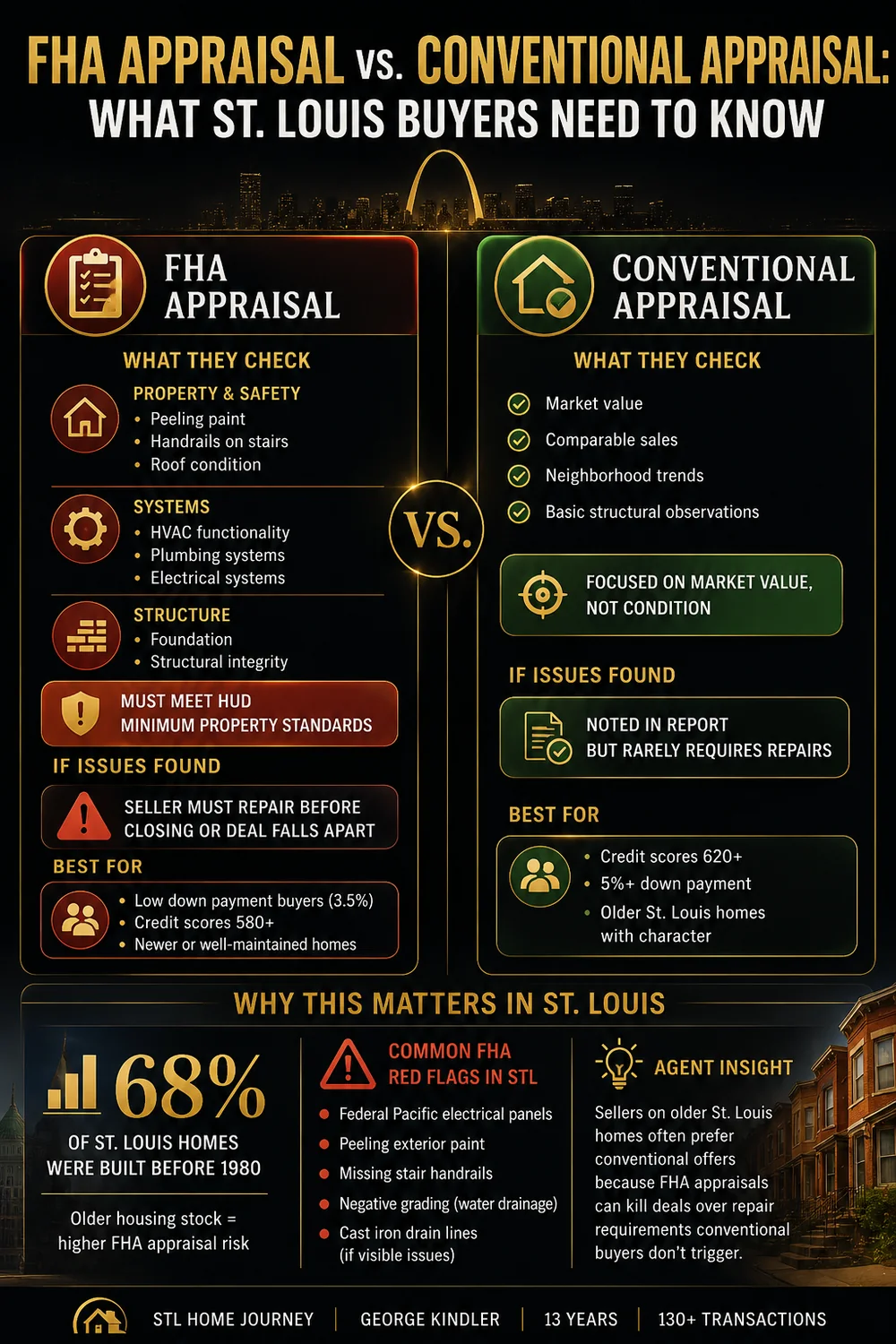
This is the section most conventional-vs-FHA articles skip -- and it is the most important distinction for St. Louis buyers looking at older homes.
Both FHA and conventional appraisals determine market value. The difference is what else the appraiser must assess.
- Market value (comparable sales)
- Property condition
- Safety hazards
- Structural integrity
- Electrical and plumbing systems
- Lead-based paint (pre-1978 homes)
- Peeling paint
- Handrails on stairs
- Roof condition and life expectancy
- HVAC functionality
- Water and sewage systems
- Foundation cracks
- Market value (comparable sales)
- Neighborhood trends
- Basic structural observations
- Property characteristics (bed/bath count, square footage, lot size)
- Overall appeal and marketability
Note: Conventional appraisers may note condition issues in the report, but they rarely trigger repair requirements or stop the loan from closing.
Loan type affects how much protection you have against condition problems — but it doesn't eliminate the risk. Understanding cheap house regrets in St. Louis is important regardless of which loan path you take.
What FHA Appraisers Must Flag
FHA appraisers follow HUD's Minimum Property Standards. If any of the following are found, they must be noted in the appraisal report and typically must be corrected before the loan can close:
- Peeling paint on exterior or interior (especially on homes built before 1978 due to lead paint risk)
- Missing or loose handrails on stairs or elevated walkways
- Exposed electrical wiring or non-functioning electrical systems
- Non-functioning HVAC systems or major mechanical deficiencies
- Roof damage with less than 2 years of remaining life
- Water intrusion or active leaks
- Foundation cracks indicating structural movement
- Negative grading causing water to flow toward the foundation
- Trip hazards on walkways, stairs, or porches
- Cracked or broken windows
- Evidence of wood-destroying insects (termites)
What Conventional Appraisers Focus On
Conventional appraisals focus on market value. The appraiser's job is to confirm the home is worth what the buyer is paying based on recent comparable sales in the area.
Conventional appraisers do observe the home's condition and note obvious issues in the report, but these observations rarely stop the loan from closing. The appraiser might note "deferred maintenance" or "functional obsolescence," but the lender typically does not require repairs unless the issue directly affects the property's structural integrity or marketability to a catastrophic degree.
This makes conventional loans significantly more flexible for older homes with cosmetic issues, deferred maintenance, or systems nearing the end of their useful life.
Why This Matters in St. Louis
Common FHA Appraisal Red Flags in St. Louis Homes
Based on 13 years of transactions in the St. Louis market, these are the most common FHA appraisal issues that delay or kill deals:
Exposed electrical wiring or missing junction box covers are common in older St. Louis homes, especially in unfinished basements. FHA appraisals flag exposed wiring as a safety hazard and require it to be properly enclosed before closing. Cost: $300 to $1,500 depending on extent.
Peeling exterior paint on homes built before 1978 triggers FHA lead paint protocols. All peeling paint must be scraped, primed, and repainted by a lead-certified contractor. This can add $3,000 to $8,000 to the seller's cost -- or kill the deal if the seller refuses to address it.
Negative grading (ground sloping toward the foundation instead of away) is common on older St. Louis lots. FHA appraisers flag this as a drainage issue. Fixing it requires regrading, which can cost $2,000 to $6,000 depending on the severity.
Full breakdown of repair costs St. Louis buyers encounter during inspections and appraisals. St. Louis Home Repair Cost Guide → →How Sellers React to FHA vs. Conventional Offers
Sellers on older homes with known condition issues often prefer conventional offers because the appraisal is less likely to require repairs before closing.
In a multiple-offer situation where one buyer is FHA at $240,000 and another is conventional at $240,000, the conventional buyer has a significant advantage -- even though the price is identical. The seller knows the FHA appraisal carries repair risk that the conventional appraisal does not.
This does not mean FHA buyers cannot compete. It means your agent needs to acknowledge the appraisal risk in your offer and potentially offer a higher price, faster timeline, or stronger earnest money to compensate for that risk. (More on competing on terms in our guide to winning multiple offers without overpaying.)
Does FHA, VA or USDA Make Your Offer Weaker?
Not automatically.
A seller isn’t really choosing a loan program. They’re choosing an offer and evaluating whether they believe that offer will close.
Financing can be part of that evaluation, but so can:
- purchase price
- buyer qualification
- lender quality
- appraisal risk
- property condition
- requested seller concessions
- inspection terms
- closing timeline
- competing offers
Sometimes a seller or listing agent may perceive Conventional financing as simpler.
That perception isn’t the same thing as saying FHA, VA or USDA financing is inherently weak.
A well-qualified buyer with a strong lender and financing that fits the property can still write a very strong offer.
The important question is whether the financing creates a problem for this house and this transaction, not whether someone has a blanket opinion about the letters on the preapproval.
Your Mortgage and Your Down-Payment Assistance Aren’t Necessarily the Same Decision
This is where first-time buyers often get understandably confused.
FHA, Conventional, VA and USDA describe ways the underlying purchase can be financed.
Programs such as MHDC can involve another layer of eligibility and assistance.
So don’t start with:
Which first-time-buyer loan should I get?
Start with two questions:
Which underlying mortgage fits me and the property?
and then:
Is there an assistance program I qualify for that works with that financing?
Those questions are related, but they aren’t identical.
If keeping more of your savings is important, compare the financing first and then review my St. Louis first-time home buyer programs and assistance guide.
For Missouri buyers specifically considering MHDC, I also have a separate guide to MHDC First Place and Next Step so the detailed program rules don't have to be crammed into this mortgage comparison.
Which Loan Should You Investigate First?
There isn’t a universal winner.
Conventional deserves a serious look if:
You qualify for competitive Conventional terms, want to compare low-down-payment options, value the possibility of eventually removing PMI, or you’re purchasing a property where a government-backed loan could create additional transaction friction.
FHA deserves a serious look if:
Its underwriting structure fits your financial profile and the combination of down payment, rate and mortgage insurance produces a better overall option than the Conventional alternatives available to you.
VA deserves a serious look if:
You’re eligible.
Don’t dismiss VA simply because another loan looks more familiar. Compare the funding fee, exemption status, interest rate, zero-down option and absence of monthly mortgage insurance before deciding.
USDA deserves a serious look if:
Your household appears eligible and you’re considering a property that may fall within USDA-eligible geography.
Don’t assume a property qualifies because it’s outside St. Louis City—or fails because it looks suburban. Check the actual address.
Don’t Ask Which Loan Is “Best.” Ask What Changes.
Take the same house and change the financing.
What happens to:
- the cash you need up front?
- the amount you borrow?
- the monthly payment?
- mortgage insurance?
- the property you can buy?
- the strength and complexity of the transaction?
- the money you still have after closing?
That’s a much more useful comparison than simply asking whether FHA or Conventional is “better.”
The house may be identical.
The financing isn’t.
Sources & methodology
- FHA: HUD — FHA Mortgage Insurance Premium Structure (1.75% upfront MIP; annual MIP tiers)
- FHA: HUD — FHA Single Family Housing Policy Handbook 4000.1 (3.5% minimum required investment; financing of upfront MIP)
- VA: U.S. Department of Veterans Affairs — VA Funding Fee and Loan Closing Costs (funding-fee rates, first vs. subsequent use, down-payment tiers, exemptions)
- VA: U.S. Department of Veterans Affairs — VA Purchase Loan (no VA-required down payment under applicable circumstances; no PMI; eligibility)
- USDA: USDA Rural Development — Single Family Housing Guaranteed Loan Program 101 (1% upfront guarantee fee; 0.35% annual fee; property and household-income eligibility)
- USDA: USDA — Property Eligibility (verify a specific address)
- Conventional: Fannie Mae — 97% Loan-to-Value Options (97% LTV transactions; first-time-buyer requirement for the standard 97% option; HomeReady)
- Conventional: Consumer Financial Protection Bureau — PMI Cancellation (request at 80% of original value; automatic termination at 78%)
Calculator defaults (7.00% illustrative rate, property taxes of 1.12% of price, homeowners insurance of 1% of price, 0.60% estimated PMI) are illustrative assumptions used across STL Home Journey’s affordability tools, not market quotes. See the calculator methodology above for how each payment is estimated.
How your credit score affects your loan options, interest rate, and monthly payment in St. Louis. What Credit Score Do You Need to Buy a Home in St. Louis? → → See how mortgage insurance affects your true monthly cost across 79 St. Louis zip codes. St. Louis Affordability by Zip Code → →FHA vs. Conventional FAQ
What credit score do I need for conventional vs. FHA in St. Louis?
FHA requires a minimum of 580 for 3.5% down (or 500 with 10% down). Conventional typically requires 620 minimum, with 700+ giving you access to the best rates and lowest PMI costs.
What is the difference between FHA and conventional appraisal requirements?
FHA appraisals must assess property condition, safety hazards, and HUD Minimum Property Standards in addition to market value. FHA appraisers flag peeling paint, missing handrails, electrical hazards, roof damage, and plumbing issues. Conventional appraisals focus primarily on market value and comparable sales. On older St. Louis homes, FHA appraisal requirements are significantly stricter.
Is FHA or conventional better for older homes in St. Louis?
Conventional is generally better for older St. Louis homes. FHA appraisals follow stricter property condition standards and flag safety issues that conventional appraisals don't assess. With 68% of St. Louis housing stock built before 1980, older homes with deferred maintenance are more likely to fail FHA appraisal requirements. Sellers on older homes often prefer conventional offers for this reason.
Can I cancel mortgage insurance on an FHA loan?
No -- if you put less than 10% down on an FHA loan, mortgage insurance premium lasts the entire life of the loan. The only way to eliminate it is to refinance into a conventional loan after reaching 20% equity. Conventional PMI is automatically cancelled at 20% equity.
What are common FHA appraisal red flags in St. Louis?
Common FHA appraisal issues in St. Louis include: exposed electrical wiring or missing junction box covers, peeling exterior paint on pre-1978 homes, missing handrails on stairs, negative grading causing water drainage issues, visible foundation cracks, non-functioning HVAC systems, and cast iron drain line problems. These must be repaired before FHA loan closing but don't typically stop conventional loans.
What is the FHA loan limit in St. Louis County for 2026?
FHA loan limits are updated annually by HUD. For 2026, verify current limits for St. Louis County, St. Louis City, and St. Charles County directly with an MHDC-approved lender or at hud.gov. Conventional conforming loan limits for 2026 are $832,750 for a single-family home in most areas.
Does loan type affect my offer in a competitive St. Louis situation?
Yes. Sellers on older homes with condition concerns often prefer conventional offers because FHA appraisal risk is lower. In a multiple-offer situation at the same price, a conventional pre-approval can be a deciding factor. Your agent should know when this matters and how to position your financing in your offer presentation.
Mortgage and Financing -- The Full Series
See the Full Picture
This is one piece of the St. Louis home buying process. See how it all fits together:
📚 Complete St. Louis Buyer Guide →
Grew up in South St. Louis, lived in Dogtown for 6 years, now in South County. You'll find us at Wellspring on Lindbergh on Sundays. I'm not selling you a house — I'm showing you how to think about buying or selling a house.
Ready to talk through your financing situation before you commit to anything? I work with buyers at every stage -- including before pre-approval. No pressure, no agenda.