
Is It the Right House? Answered
How do I know it’s the right house?
Check the two things you can’t change. Does the location make your daily life easier: the commute, groceries, gas, the places you go every week? Does the floor plan fit how you actually live? If both are yes, most of what’s left can be fixed or budgeted for. The three questions I ask ↓
Is it normal to feel anxious about buying a house?
Yes. Every buyer feels it, and I’ve been in your shoes on three purchases of my own. Uncertainty on its own isn’t a reason to walk away. A reason to walk away is something you can’t change and won’t accept: the location, the layout, or a problem you can’t afford to fix. Every purchase had a surprise ↓
What can’t you change after you buy a house?
The location and, for the most part, the floor plan. You can renovate a kitchen. You can’t move the house closer to your job, and you can’t make a location fit your routine if it doesn’t.
What matters more, the house or the location?
In my experience, the location. You can’t pick your neighbors, but you do get to pick your location. If you don’t like it the day you buy, you’ll still not like it years later. The house that taught me that ↓
How do I check a location before I make an offer?
Drive the routes you’ll actually drive, at the times you’ll drive them: to work, the grocery store, the gas station. Walk the street. Look up the area’s crime data yourself from the police department that covers the address. And find out which city or unincorporated area the house is in, because that sets your taxes and occupancy rules. City vs. County, explained →
What shouldn’t scare me off a house?
Things you can fix and price. Older St. Louis houses come with surprises, so budget for them, but don’t confuse a fixable problem with the wrong house. Check a specific house before you offer →






My first house: the $17,000 surprise ↓ · Before you offer: the three questions ↓ · Check a house: Before You Offer →
I Was My Own Worst Client
In 2014, right after I got my license, my wife and I, newly married with one child, decided to buy. I must have looked at 100 houses. There was far more inventory then than now, and I still couldn’t commit. It wasn’t the budget that scared me. The market was recovering, and nobody knew whether it had really hit bottom or whether I was about to buy a disaster.
I thought I had it figured out. I didn’t. It took me about five years of selling real estate to really understand pricing, housing economics, buyer psychology and what moves a market. Every step of that first purchase showed me something I didn’t know:
- My cousin, an experienced contractor and renovator, walked the house instead of a formal inspector.
- I used an FHA 203(k) renovation loan without understanding the regular buying process, let alone the 203(k) one.
- I almost missed my survey window because I assumed the title company handled it.
- The house was off market, so I handled the seller’s side too.
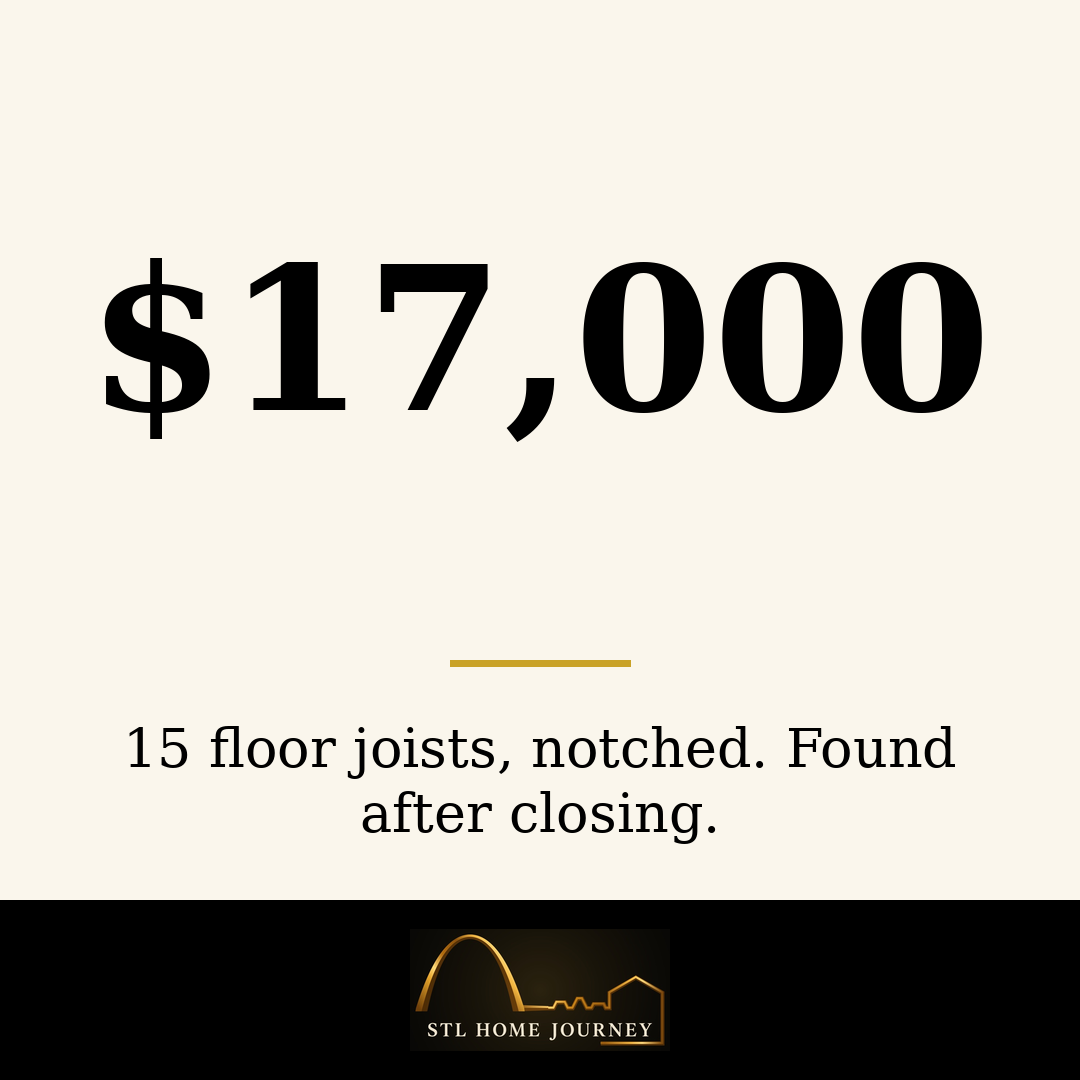
The renovation went well: a new deck, kitchen, electric, plumbing and HVAC. Then we opened the basement walls. Fifteen floor joists had been notched, and the floor across the dining room, the room that carries the most weight, had lost its strength. Fixing it cost $17,000 out of pocket, and that was with my cousin charging a fair price and no markup. All in: a $74,000 purchase, a $30,000 renovation and nearly $23,000 out of pocket with the down payment.
I was sure I’d made the biggest mistake of my life. We pushed through because we’d already closed and were on the home stretch of the renovation.
What I’d tell myself now: the risk was what’s beneath the hood, the walls, the sewer lateral, radon, termites. Know what you’re giving up, and budget for what no one can see. The St. Louis repairs that wreck budgets →
Why I’d Buy That House Again
That house cost more than I planned and scared me more than any house since. I’d still buy it again. I worked downtown, groceries and gas were five minutes away, and we were about 20 minutes from every part of St. Louis. Our daily life there was easy, and that’s what made the hard parts worth it.
We didn’t leave because it was the wrong house. We outgrew a home we loved.
The House That Taught Me About Location
Our second purchase looked better on paper. We bought from a relative with a gift of equity. It cost more than our first house and carried a higher interest rate, but the payment was lower: the gift of equity lowered our loan-to-value on a conventional loan, which improved our pricing, removed mortgage insurance and meant we brought about $1,200 to closing.
It had its own surprise. Leaves sat over the drain at the bottom of the outside basement stairwell, and the basement flooded. Small things outside a St. Louis house cause big water problems inside it. What buyers regret most after they buy →
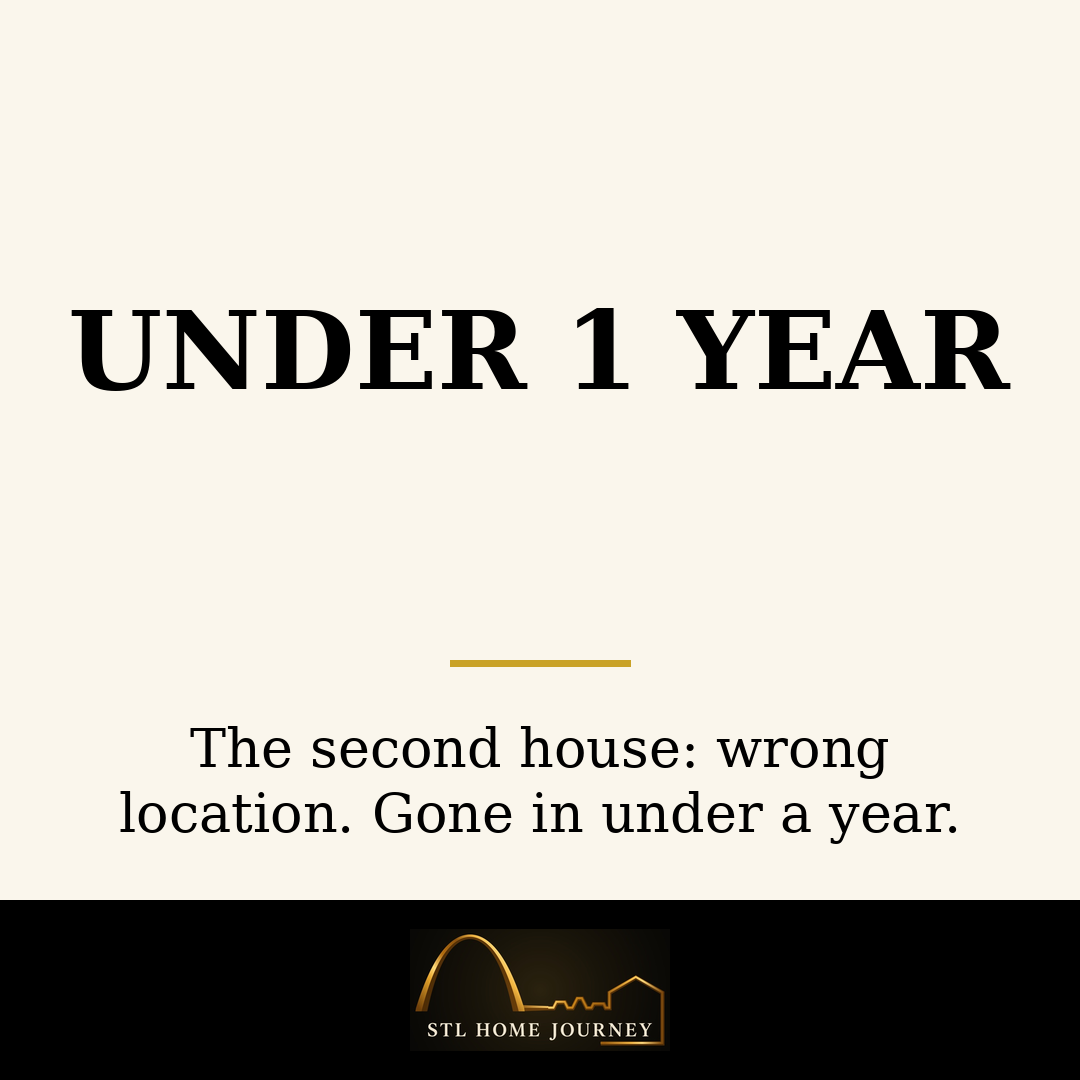
The financing worked. The location didn’t. It didn’t fit how we wanted to live day to day, and I hadn’t researched it the way I tell buyers to now, including looking up the crime data myself. We moved less than a year later.
That’s where my rule came from. Location is one of the boxes I make every buyer check. You can’t move it, and if you don’t like it today, you won’t like it later. Torn between areas? Where your budget wins →
The Third Time: Location and Floor Plan
When we moved to South County, in the Lindbergh area, we kept both earlier houses as rentals. That purchase had its surprise too: the conventional underwriter wouldn’t accept the rent income, so we switched to FHA at the last minute. FHA counted 75% of the rent on each house, which was more than each mortgage payment, so those loans didn’t count against us. Most buyers don’t know that’s possible, and it’s exactly the kind of moment where you need a plan B instead of a panic. Ask your lender how they count rental income; the rules vary by loan. Conventional vs. FHA in St. Louis →
The uncertainty was still there. Every purchase brings some, no matter how many times you’ve done it. What changed is that I knew what to check. Was it the location I wanted? Did the floor plan make daily life easier? Was there a yard for the kids to play in? Yes to all three.
Living here is easy: gas stations on every corner without it feeling commercial, and the Lindbergh strip for groceries, shopping, restaurants and entertainment. My barber shop and church are five minutes away.
What I Tell Buyers Now
Every surprise I had, the $17,000 fix, the flooded basement, the last-minute loan switch, taught me one thing about this job. I don’t want my clients to go through what I did, if I can help it. So when I walk a house, I walk it through your eyes, with everything my own purchases taught me: what could go wrong, what to avoid, where you’d sink money you’ll never get back. What I look for when we walk a house →
Before you write an offer, I ask three questions:
- Does this location make your weekday easier? The commute, groceries, gas, the places you go every week.
- Does the floor plan fit how you live? How you live now, not how you’d like to live someday.
- Is anything wrong with the house that you can’t fix or can’t afford to fix? Run the Before You Offer check →
If the first two are yes and the third is no, the nerves you’re feeling are normal. That’s what buying a house feels like.
When a seller’s counter nearly ran my buyers off in 2026, I asked them one question: if we take away how the sellers responded, does that change the house? It didn’t, and they bought it. Their Fenton purchase →
Tell Me How You’re Feeling
I spent four years in the Marine Corps, and it made me resilient to setbacks and surprises. When something goes wrong, I run the same loop: observe, orient, decide, act. That’s why I can explain where we stand and what our next options are, even when it’s stressful. Not because I’m a robot, but because you should have someone in your corner who really knows what they’re doing.
I don’t expect my buyers to react that way, and they shouldn’t have to. More than 250 sales have taught me the options for a whole host of problems, including when it’s time to cut your losses and walk away. A buyer doesn’t have those experiences to lean on. The contingencies that let you walk away →
So tell me how you’re feeling and what’s worrying you. I’ve spent a lot of hours on the phone with upset clients, crying clients and clients just trying to understand the market they’re buying in. Your agent should be able to tell when it’s time to stop, talk about how you’re feeling and understand why. Because it’s going to happen. Walking buyers through what I’ve been through, and getting them to the closing table, is the part of this job I enjoy most.
Next steps: Check a house before you offer · How much to offer · Neighborhood quiz · How I work with buyers

I’m not selling you a house. I’m showing you how to think about buying or selling a house.
The Closing Pros LLC
Licensed Missouri Real Estate Brokerage
Office: 314-998-4550 · George’s Direct Line: 314.435.1087
Stories are George Kindler’s own purchases in 2014 and later. Loan rules described (FHA counting 75% of rental income, gift of equity) applied to those loans; ask your lender how they apply to yours.