STL Home Journey
George Kindler
Buyer education for St. Louis homebuyers
Most neighborhood ranking lists sort by price or name recognition. Neither tells you whether the neighborhood fits your actual situation. This guide is organized differently — by buyer type, not by prestige.
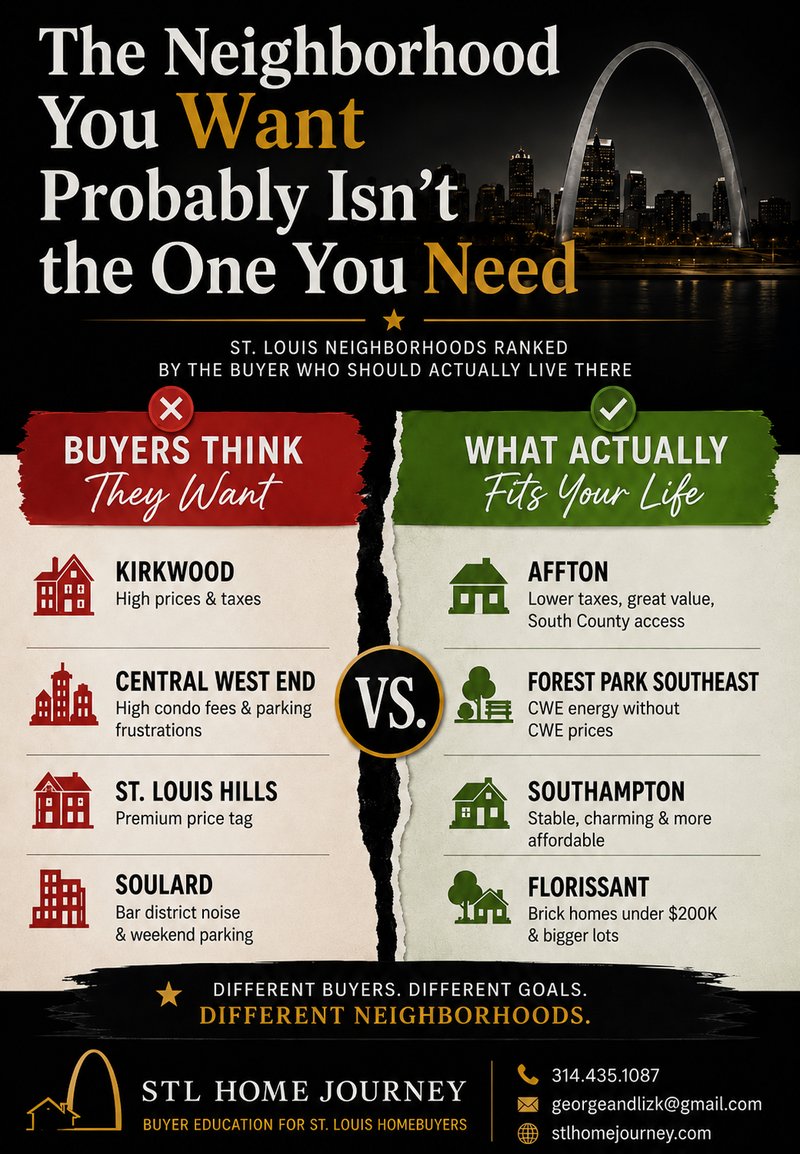
The best St. Louis neighborhood for you is not the one with the most name recognition. It is the one that matches your loan type, your commute, your school situation, your inspection tolerance, and your actual monthly budget — not just your purchase price ceiling. I have walked thousands of homes across this metro. What follows is what I actually tell buyers in consultation.
The phrase "affordable St. Louis" is real, but it requires a narrower question: affordable with what trade-offs? A $160K brick bungalow in Princeton Heights and a $160K ranch in Lemay are both under budget. They are not the same decision.
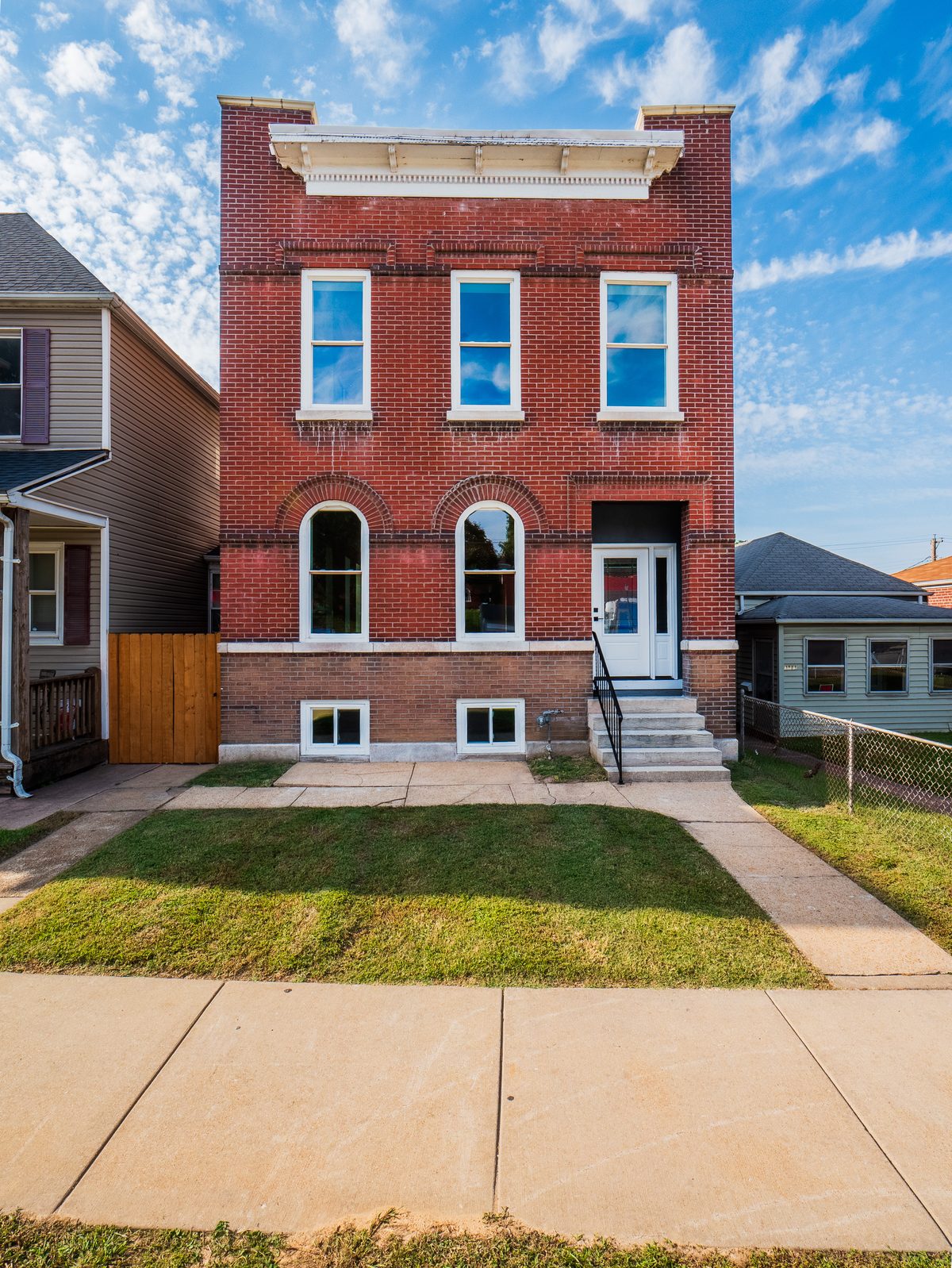
In South City, Bevo is one of the most consistent first-time buyer neighborhoods in the metro. The housing stock is 1920s-1940s brick bungalows, the entry price is genuinely below $175K on many blocks, and the construction quality is real — not flipped-to-impress. The trade-off is SLPS. St. Louis Public Schools serves every South City neighborhood without exception, and that is a meaningful part of the price difference between Bevo and South County. If your school situation is sorted — you are comfortable with SLPS, you plan private school, or you do not have school-age children — Bevo delivers brick construction and neighborhood character that South County entry-level simply cannot match at the same price.
Carondelet is the other South City answer at this price point. It sits at the southern edge of the city near the river, which means buyers who work anywhere near South County have a reasonable commute. Carondelet has a mix of 1.5-story brick homes, bungalows, and some two-flats. Inspection realities are consistent with any pre-war South City purchase: budget for sewer lateral work, cast iron drain lines that may be nearing end of life, Federal Pacific or Zinsco electrical panels, tuck-pointing, and HVAC systems that are often original or near replacement. None of those items automatically kill a deal. All of them require a real inspection budget beyond the purchase price. Read the home inspection guide and the first-time buyer programs guide before you make an offer in this price range anywhere in the city.
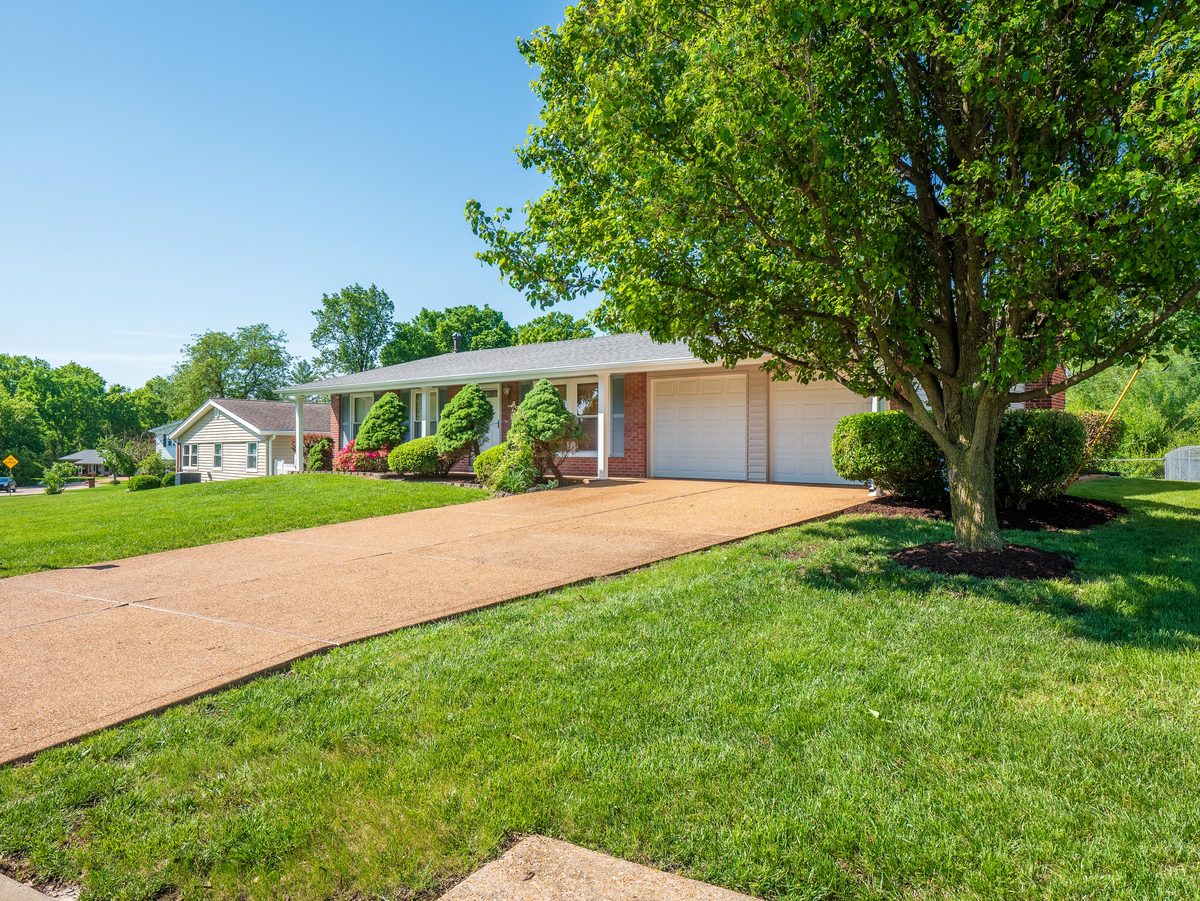
In South County, Lemay is the first-time buyer answer that does not get enough credit. Post-war ranches and split-levels, brick and brick-and-vinyl, functional layouts, and prices that still land under $200K on many streets. Lemay does not have Oakville's name recognition or school district pull, which is exactly why the price is accessible. The commute to South County employers or downtown is practical. The inspection profile on post-war construction is more predictable than pre-war city brick — you are still looking at HVAC age, roof condition, and basement water management, but you are less likely to find the cast iron drain and Federal Pacific combination that shows up routinely in the city.
In North County, Florissant has one of the deepest first-time buyer markets in the entire St. Louis metro. Ranch inventory, brick and vinyl, established infrastructure, strong commute access. Florissant has more first-time buyer transaction volume than almost anywhere else in the market. That is not a coincidence — it is what happens when a community has sustained demand from buyers who are doing the math rather than buying the name.
The one neighborhood that sounds right but usually disappoints first-time buyers at this price point: Maplewood. The coffee shops and restaurant scene are real, but sub-$200K inventory in Maplewood is extremely limited and moves fast. First-time buyers who target Maplewood often end up frustrated by competition and eventually overpay or land in a less desirable situation than if they had started with Bevo or Lemay.
If you are a first-time buyer under $200K and you want brick construction, real neighborhood character, and a purchase that holds up to honest inspection, start with Bevo, Carondelet, Princeton Heights, Southampton, or Lemay. Stop reading and go look at those neighborhoods.
The medical and academic corridor in St. Louis is one of the strongest employer anchors in the metro. WashU Medicine, BJC HealthCare, Barnes-Jewish, St. Louis Children's Hospital, and the related research and academic infrastructure create consistent buyer demand for neighborhoods within a reasonable daily commute. The challenge is that the neighborhoods closest to that corridor are also among the most expensive in the city.
The Central West End is the obvious answer, and for many medical and academic buyers it is the right one. Direct adjacency to Forest Park, WashU, and BJC. Walkable by St. Louis standards. The housing stock is a mix of historic condos, fee-simple townhouses, converted apartment buildings, and some detached houses on quieter blocks. The trade-off is that the CWE rewards buyers who understand what they are buying. This is not a market where you make an offer based on photos and square footage. HOA structures, parking arrangements, condo reserve funds, building maintenance quality, and renovation history all matter. The per-square-foot cost here is higher than almost anywhere else in the city.
Forest Park Southeast — which most people know as the Grove corridor — is the second answer. It is closer to the medical campus than many buyers realize, and the entry price is meaningfully lower than the CWE. The Manchester Avenue entertainment district runs through it, which is a lifestyle asset for younger buyers and a noise consideration for others. The residential streets behind Manchester have pre-war brick housing stock that delivers on character. SLPS applies here as in all South City neighborhoods.
The Hill is a ten-minute drive to BJC and WashU, and it is one of the strongest neighborhood identity plays in South City. The Italian heritage, the restaurant culture, the compact and well-maintained blocks — buyers who want to buy a neighborhood as much as a house often land here. The Hill prices have moved up significantly, and the inventory is limited. What sells here moves quickly.
For hospital system employees who want more space, a yard, and better school options at the cost of a longer commute, Webster Groves and Kirkwood are the standard answer. Both are 20-25 minutes from the medical campus, both have strong school districts, and both have well-maintained older housing stock. The entry price in Webster Groves and Kirkwood reflects all of that demand — buyers priced out of those markets should read the next section.
The disappointment pick for hospital employees: University City. The neighborhood has appeal and real architectural character on its better blocks, but block-by-block variation is significant, the school district situation is complex, and buyers who do not do their homework on specific streets sometimes land in situations they did not expect.
If you work at BJC or WashU and you want to walk to work, live in the CWE. If you want to drive ten minutes and spend less, look at the Hill, Forest Park SE, or Dogtown. Stop reading and go look at those three options.
VA buyers in St. Louis face a specific challenge that most online neighborhood guides ignore entirely: VA minimum property requirements. A VA appraiser will flag peeling paint, foundation movement, exposed wiring, non-functional mechanical systems, Federal Pacific electrical panels, and structural concerns. Those items require seller repair or seller credit before the loan closes — and sellers, especially investors and as-is sellers, often will not agree to those terms.
That makes pre-war South City brick a complicated fit for many VA buyers. The neighborhoods with the most character and the most affordable pricing — Bevo, Carondelet, McKinley Heights, Fox Park — are also the most likely to have inspection findings that create VA friction. Cast iron drain lines do not automatically fail VA appraisal, but Federal Pacific and Zinsco panels often do. Read the Federal Pacific panel VA loan guide and the fixer-upper VA loan guide before you make offers in the city.
That complexity is worth understanding before you start touring. what buyers regret most after buying a cheap house in st. louis explains the infrastructure risks that come with older St. Louis housing stock — and how to evaluate them correctly.
South County post-war ranches are generally the strongest fit for VA buyers. Mehlville, Affton, and Lemay have inventory that was built in the 1950s-1970s, which is more VA-compatible than 1920s-1940s construction. You are still looking at roof age, HVAC condition, basement water, and electrical updates — but the Federal Pacific combination is less common, and sellers in these submarkets are more accustomed to working with VA buyers.
Florissant and Hazelwood in North County are also strong VA markets. The transaction volume here is high enough that sellers and agents understand VA purchase requirements. Ranch inventory, post-war construction, and a competitive price point make North County a consistently viable option for VA buyers who do not need to be in South County.
Oakville works for VA buyers who have more budget flexibility. The price point is higher, but the housing stock tends to be in better condition, sellers are more likely to complete minor repairs, and the post-war to 1980s construction profile is generally VA-compatible. Oakville buyers pay a premium for the school district and location pull, and the VA loan works well here when the price supports the appraisal.
The disappointing pick for VA buyers: Any South City neighborhood with a majority of investor-owned or as-is listed properties. The charm is real, but if the seller will not address MPR findings — and many investor sellers will not — you will lose the deal at appraisal or pay out of pocket for repairs that should have been a seller condition.
VA buyers who want South County should start with Mehlville, Affton, and Lemay. VA buyers open to North County should look at Florissant and Hazelwood. Stop reading and go talk to a VA-experienced lender and then tour those submarkets.
Rental demand in St. Louis is real and relatively durable compared to most Midwest metros its size. The combination of large employer anchors — WashU, BJC, Boeing, Anheuser-Busch, multiple hospital systems — with a population that rents at a healthy rate means that landlord math can still work here. The question is where.
Florissant is one of the strongest landlord markets in the metro for straightforward rental math. Ranch inventory, consistent tenant demand, and a price point that allows reasonable returns. Florissant is not a high-appreciation play. It is a cash-flow-first market for landlords who want occupancy over upside. If you are buying rentals and you want the unit to be occupied and the tenants to be stable, Florissant delivers that more reliably than most of the city.
South City brick bungalows in Bevo, Carondelet, and Dutchtown are strong rental plays for landlords who understand the maintenance profile. Pre-war construction holds up when maintained and fails badly when ignored. Cast iron drain lines, tuck-pointing, and basement water management are recurring maintenance items that smart landlords budget for systematically rather than treating as emergencies. The rents in South City have moved up meaningfully, and the buyer competition for well-maintained rentals is real.
Lemay and older sections of Mehlville are solid investor plays for landlords who want South County demand without Oakville pricing. Tenant demand is consistent, the housing stock is practical and maintainable, and the price point creates enough spread for rental returns that are difficult to find in the closer-in neighborhoods.
For investors specifically interested in as-is or distressed acquisitions, the Cash Offer Decoder is the right starting point for running the actual math before making offers. The difference between a deal that works and a deal that traps capital is almost always in the repair estimate and carrying cost calculation, not the purchase price headline. See also the cash offer guide for the seller's perspective on why deals at certain price levels make or break.
The disappointing pick for investors: South City blocks with high vacancy rates and deferred maintenance on neighboring properties. The purchase price can look attractive until you model the tenant quality, turnover, vacancy, and maintenance costs that come with a distressed corridor. Block selection matters more than neighborhood name for investors in the city.
Investors who want cash flow should start with Florissant. Investors who want South City character with rental upside should look at Bevo, Carondelet, and Dutchtown. Stop reading and run the actual numbers before you make an offer anywhere.
School-driven buyers in St. Louis are essentially choosing between the city and the county. St. Louis Public Schools serves the entire City of St. Louis — there is no school district variation across South City, no matter how nice the neighborhood looks. Buyers who need to be in a specific county district are buying into county municipalities, not the city.
In South County, Oakville and the Mehlville School District create the clearest school-driven buyer premium in the metro. Oakville is the most sought-after address inside the Mehlville district, and it shows in the prices. Buyers who want Oakville schools should expect competition on well-priced homes and limited forgiveness on condition. The post-war to 1980s housing stock in Oakville is generally sound — roof, HVAC, and basement water are the typical inspection categories, not the more complex pre-war issues of the city.
Mehlville proper gives families the same school district access as Oakville at a lower price point. The attendance area assignment matters — Mehlville and Oakville streets are both in the Mehlville School District, but the district is large and buyer perception of Oakville vs. Mehlville creates a price gap that is not fully explained by school quality. Buyers who do the research on actual school assignments and are not buying the Oakville address specifically will find better value in Mehlville. The Lindbergh vs Mehlville comparison explains exactly where that boundary runs and what it means for buyers on either side.
Webster Groves and Kirkwood are the gold standard for school-driven families in the inner ring. Both have independently recognized school districts (Kirkwood, Webster Groves), strong community infrastructure, and housing stock that ranges from affordable bungalows to significant single-family homes. The entry price in both markets is higher than South County, and inventory is competitive. Buyers priced out of Webster Groves should read the next section.
In North County, Florissant and Hazelwood have school district options that serve families who want suburban infrastructure at a more accessible price point. The Hazelwood School District has served a large and diverse community for decades. Buyers in these markets get suburban housing, reasonable commutes, and school districts with real infrastructure at price points that are considerably more accessible than South County or the inner ring.
The disappointing pick for school-driven families: Maplewood-Richmond Heights. The school district is small and the community is tight-knit, but the housing inventory is extremely limited at school-family price points, and buyers often wait a long time for something to come available that meets their criteria.
School-driven families who can afford it should look at Oakville, Webster Groves, or Kirkwood. School-driven families working with a tighter budget should look at Mehlville and Florissant. Stop reading and verify the exact school assignment for the specific streets you are considering before you make any decision based on neighborhood name.
The price gap between Oakville and its neighbors is one of the more useful arbitrage opportunities in the St. Louis market. Oakville carries a premium that reflects name recognition, school perception, and location more than it reflects meaningful differences in housing quality from one street to the next. Buyers who understand that are the ones who find the best value in South County.
Affton is the most direct Oakville alternative. The housing stock is comparable — post-war ranches, brick and brick-and-vinyl, solid construction — and the price is meaningfully lower. Affton sits just north and west of the Mehlville district boundary, and it has its own school district identity that buyers should verify carefully by address. For buyers where the school situation works, Affton delivers South County suburban character at a price that has not fully caught up to the demand that is there.
Mehlville is the same conversation on the east side of South County. Same district, lower price than Oakville, same basic housing character. The distinction is perception, not construction quality. Buyers who are doing the actual research rather than searching by neighborhood name find that Mehlville streets and Oakville streets separated by a half mile often have nearly identical homes at meaningfully different prices.
Lemay is the value play for buyers who want to be in South County and are flexible on exactly which pocket. Lemay prices are the most accessible in the South County corridor. The housing stock is practical, the commute infrastructure is solid, and the neighborhood has more demand than its pricing currently reflects. Buyers who get into Lemay at today's prices are well positioned as that gap closes.
Concord and Sappington sit between Mehlville and Oakville in both price and perception, and both offer good value for buyers who have done the comparison. Arnold and Imperial in Jefferson County are worth considering for buyers with more budget flexibility but who are willing to trade some commute time for significantly more space and a lower entry price.
The disappointing pick for buyers seeking suburban value: Crestwood. It has a good reputation, but the price-to-value ratio has compressed significantly in recent years. Buyers who think Crestwood is a discount to Kirkwood or Webster Groves often find that the discount is smaller than expected while the inventory remains tight.
South County buyers who want value without sacrificing suburban feel should start with Affton, Mehlville, and Lemay. Stop reading and compare specific streets in those three before you anchor on any single neighborhood name.
Getting priced out of your first-choice neighborhood is one of the most common buyer experiences in St. Louis right now. Webster Groves, Kirkwood, Soulard, The Hill, Oakville — these markets move fast and forgive nothing on price. The buyers who do well are the ones who identify the nearest structural equivalent before they are emotionally committed to a neighborhood they cannot afford.
Priced out of Webster Groves? Look at Affton. The housing construction era is similar — post-war ranches and bungalows, brick and brick-and-vinyl, established tree canopy — and the price is significantly lower. Affton does not have the Webster Groves name, the Douglass Theater, or the Webster identity. It has the physical neighborhood without the brand premium.
Priced out of Kirkwood? Look at Maplewood. Different city, different school district, different commercial identity — but the proximity to the inner ring, the walkability relative to most of the metro, and the housing character at Maplewood's price point often satisfy buyers who started Kirkwood searches.
Priced out of Soulard or The Hill? Southampton, McKinley Heights, Princeton Heights, and Carondelet all deliver genuine pre-war or post-war South City brick character at a fraction of Soulard's price point. The difference is neighborhood recognition and in some cases the specific commercial corridor. The bricks are the same. SLPS applies in all of them, just as it does in Soulard itself.
Priced out of Oakville? Mehlville, Affton, and Lemay are the structured alternatives. Same basic housing stock, same general South County geography, and in the case of Mehlville, the same school district. The price gap between Oakville and its neighbors is almost entirely driven by name and perception, not by housing quality differences that show up in daily life.
Priced out of the Central West End? Forest Park Southeast, Dogtown, and Tower Grove South all sit within a reasonable commute of the CWE's employment anchors and offer similar urban character at lower prices. The CWE itself has significant inventory variation — buyers who think the entire CWE is out of reach sometimes find that specific blocks or building types are more accessible than the neighborhood average suggests.
The honest truth about priced-out scenarios: The reason your first-choice neighborhood is expensive is usually supply and demand — more buyers want it than there are homes available. The substitute neighborhoods are substitutes for a reason. That does not mean the substitute is wrong for you. It means you should understand what you are trading and what you are keeping before you decide.
Buyers who have been priced out of their first choice should identify the two or three neighborhoods with the same structural characteristics and price two levels down. Stop reading and start a side-by-side comparison today.
Cash buyers and as-is investors in St. Louis have a specific problem: the market that looks most attractive on price is often the market with the most hidden cost. A $90,000 brick flat in Dutchtown and a $90,000 brick flat in a struggling North City corridor may both look like the same number. They are not the same decision.
The most important variable for as-is buyers is block condition and tenant demand trajectory, not neighborhood name. A well-maintained block in Bevo or Carondelet with active owner-occupant presence and street maintenance is a fundamentally different investment than a block with high vacancy and deferred maintenance on every neighboring property, even if the purchase prices are similar.
For cash buyers who want South City as-is inventory with credible rental demand, Bevo, Carondelet, Dutchtown, and Gravois Park are the submarkets where investor activity has been most consistent. These neighborhoods have active landlord communities, reasonable tenant demand, and enough owner-occupant presence to stabilize block character. Sewer lateral work, tuck-pointing, and HVAC replacement are recurring costs that cash buyers should budget on every acquisition rather than treating as optional.
For cash buyers targeting South County as-is properties — inherited homes, vacant houses, tired rentals — Lemay and older sections of Mehlville offer investor demand and a more predictable maintenance profile than city brick. The post-war construction is more straightforward to evaluate and repair. The rental demand is supported by the South County employment base and the Mehlville school district pull.
Before accepting or making any as-is cash offer in this market, run the numbers with the Cash Offer Decoder. The difference between a deal that generates returns and a deal that absorbs capital indefinitely is almost always in the repair estimate and the honest vacancy modeling, not the purchase price.
The cash buyer trap: North City properties at very low price points where the block condition, vacancy rate, and insurance environment make the numbers look attractive on paper but fail in practice. Low purchase price does not compensate for inability to insure the property, difficulty finding and retaining tenants, and an extended timeline to stabilize the investment.
Cash buyers and as-is investors with realistic timelines and maintenance budgets should focus on Bevo, Carondelet, Dutchtown, Florissant, and South County ranches in Lemay and Mehlville. Stop reading and run actual numbers before you make offers.
What is the best affordable neighborhood in St. Louis?
For buyers under $200K who want real brick construction, Bevo, Carondelet, Princeton Heights, Southampton, and McKinley Heights are the strongest options in South City. In South County, Lemay and Affton offer brick ranches at competitive prices. In North County, Florissant has the deepest inventory of affordable homes with established infrastructure.
What neighborhoods work best for VA buyers in St. Louis?
VA buyers need to think carefully about property condition because VA appraisers will flag Federal Pacific electrical panels, cast iron drain issues, foundation concerns, and peeling paint. South County ranches in Mehlville, Affton, and Lemay tend to work well because post-war construction is more VA-compatible than pre-war South City brick. Florissant and Hazelwood in North County also have strong VA-eligible inventory.
Is South City cheaper than South County?
Entry prices in South City can be lower, but total cost of ownership is not always lower. South City brick from the 1920s-1950s often has deferred maintenance, cast iron drain lines, older electrical panels, and sewer lateral concerns that add $10,000-$30,000 to early ownership costs. South County post-war ranches can be more predictable to maintain even if the entry price is similar.
What St. Louis neighborhoods are closest to BJC and WashU Medical?
The Central West End is the closest residential neighborhood to both BJC HealthCare and WashU Medicine. Forest Park Southeast, The Hill, Dogtown, and Maplewood all offer reasonable commutes under 15 minutes. For buyers who want more space, Webster Groves and Kirkwood are 20-25 minute commutes.
What St. Louis neighborhoods still have brick homes under $250K?
South City neighborhoods including Bevo, Carondelet, Gravois Park, Dutchtown, Princeton Heights, Southampton, McKinley Heights, and Fox Park all have active inventory under $250K with genuine brick construction. In South County, Lemay, Affton, and older sections of Mehlville have brick or brick-and-vinyl ranches under $250K.
What are the best St. Louis neighborhoods for first-time buyers?
First-time buyers under $200K should look at Bevo, Carondelet, Princeton Heights, and Southampton in South City, and Lemay, Affton, and older Mehlville in South County. Florissant in North County has one of the strongest first-time buyer markets in the metro. The key in every case is budgeting for inspection findings beyond the purchase price.
Answer 7 questions about your lifestyle, commute, and priorities. The Neighborhood Matcher scores you against every major St. Louis area and shows which ones fit.
Open Neighborhood Matcher →See which St. Louis neighborhoods offer a genuinely equivalent home on both paths within 5% of the same total cost. FHA, VA, and conventional math included.
Run the Comparison →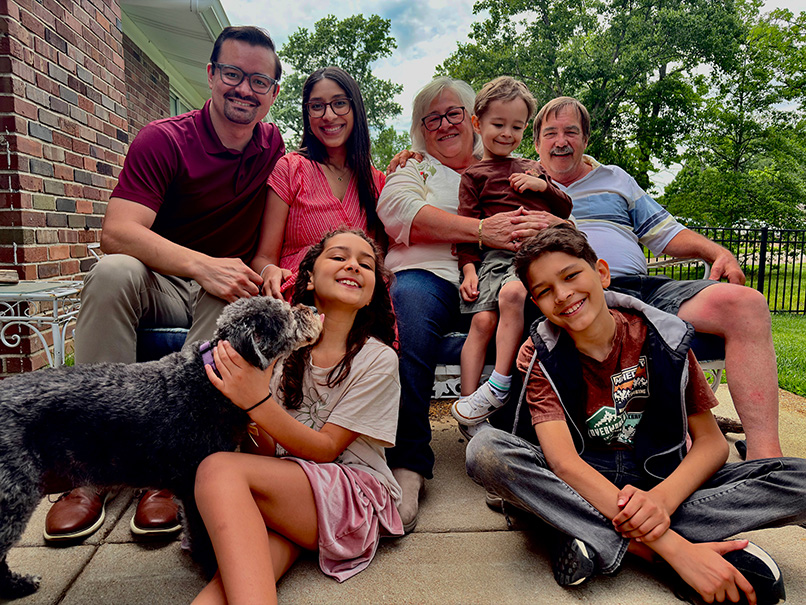
I grew up in South St. Louis, lived in Dogtown, and now live in South County. I have walked these neighborhoods in every condition and every market. If you want a straight conversation about which one fits your situation — not a sales pitch, not a neighborhood ranking list — call or email.